Reading the B-H Loop: Retentivity, Coercivity and Why Hysteresis Costs Energy
- Published
- Author
- Komal Ganvir
- Reads
- 448
Magnetic hysteresis means magnetization lags the applied field. The B-H loop shows why soft and hard magnetic materials suit such different jobs.
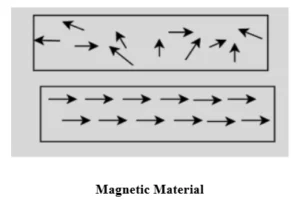
Magnetic hysteresis is the reason a transformer core dissipates energy on every AC cycle and the reason a hard drive platter keeps its data after power is gone. Both come down to one behaviour. In a magnetic material, flux density (B) doesn't retrace its own path when the field strength (H) reverses, and the gap between the rising and falling curves is where most of the practical engineering sits.
Why the Path Doesn't Retrace Itself
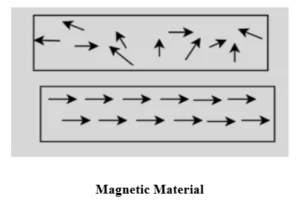
Magnetization follows a different route on the way up than on the way down. In ferromagnetic materials, the magnetic domains rotate and shift to line up with the applied field. Domain walls don't move freely, though. Imperfections in the crystal structure pin them in place, so when the field drops, the domains don't all return to their starting arrangement. That friction is the physical origin of the lag, and it's why the curve closes into a loop instead of folding back on itself.
Reading the Loop Stage by Stage
The loop is easiest to understand as a sequence of events. Start with a demagnetized sample and increase H from zero. B rises as the domains align with the field. The rate of rise slows as the material approaches saturation, the point where most domains are already aligned and additional field strength adds only a small increase in magnetization.
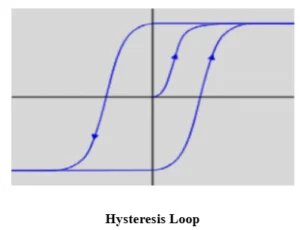
Now reduce H to zero. B doesn't drop to zero with it. The flux that remains is the residual magnetism, also called retentivity. To bring B back to zero, you have to apply a field in the opposite direction, and the magnitude of that reverse field is the coercive force, or coercivity. Keep increasing the reverse field and the material saturates in the opposite direction. Cycle the field back through zero and back to the positive saturation point, and the path closes into the familiar loop.
The useful reading is this: the loop's width reflects how much the material resists changes in its magnetic state, and its two intercepts give you the numbers that matter for design. The point where the loop crosses the B axis is retentivity. The point where it crosses the H axis is coercivity.
Retentivity and Coercivity as Design Parameters
These two properties pull in opposite directions for most applications. High retentivity means a material holds its magnetism after the field is removed, which is what a permanent magnet needs. High coercivity means the material resists being demagnetized by an external field, which keeps that magnet stable when it's exposed to opposing fields in a motor or a sensor.
Soft magnetic materials sit at the other end. They have low retentivity and low coercivity, so they're easy to magnetize and easy to demagnetize. That's exactly what you want in a core that's being driven back and forth thousands of times per second. Choosing between soft and hard materials is largely a choice about where you want the loop to sit.
Soft Versus Hard Magnetic Materials
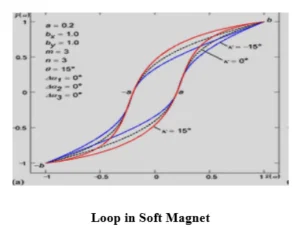
Soft magnetic materials have a narrow hysteresis loop with low coercivity and low retentivity. They magnetize and demagnetize with little effort, and the narrow loop means relatively low hysteresis losses per cycle. That combination makes them the default for transformers, motors, generators and electromagnets, where the field is constantly changing and wasted energy shows up as heat.
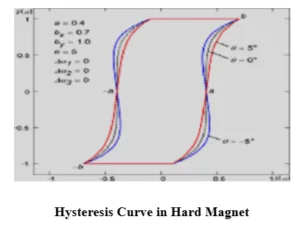
Hard magnetic materials are the mirror image. Their loop is wide, with high coercivity and high retentivity. They hold their magnetism after the external field is gone and resist being pushed back. Those properties make them suitable for permanent magnets and for magnetic storage, where the stored state has to survive without power.
What the Loop Area Tells You About Energy
Every time a material is taken around a full magnetization cycle, some energy is dissipated as heat. That's hysteresis loss. The energy lost per unit volume in one cycle is represented by the area enclosed by the B-H loop, so a wider loop generally means more loss under the same operating conditions.
This is why the choice of core material matters so much in AC equipment. A transformer core cycles continuously, so even a modest loop area repeats every cycle and accumulates into real thermal load. Engineers in this position typically weigh the narrower loops of soft materials against the other requirements of the device, since the lowest-loss material isn't always the one that meets every constraint.
Where Each Class of Material Ends Up
In practice, the split follows the loop shape. Hard magnetic materials turn up in permanent magnets, hard disk drives, magnetic recording equipment, magnetic tapes and cassettes, and magnetic cards, where retaining a stored state is the point. Soft magnetic materials are found in transformers, solenoids, electromagnets, relays, and electric motors and generators, where the field needs to switch quickly and cleanly with minimal waste.
Demagnetization is also a practical concern. The source material notes that retained magnetism can be reduced by applying a field in the opposite direction or by heating the material appropriately. The reverse-field method is the one that maps directly onto the loop: you're moving the operating point back through coercivity until B reaches zero.
What to Take From the Loop
If you're specifying a magnetic component, start with the loop. A narrow loop with low coercivity points toward soft materials and low-loss cores. A wide loop with high retentivity and coercivity points toward hard materials and permanent magnets. The shape tells you whether the material will hold its state, how much energy it'll waste each cycle, and how hard it'll fight a reversal. Those three answers usually decide the material before the datasheet does.