Eddy Currents Explained: Loss, Braking, and Non-Destructive Testing
- Published
- Author
- Komal Ganvir
- Reads
- 418
Eddy currents cause unwanted heating in cores but also enable contactless braking and flaw detection. Here's how the physics works and where engineers manage it.
Eddy currents are one of those effects that engineers spend part of their career fighting and the rest of it exploiting. The same induced loops that heat a transformer core also slow a train without a brake pad touching anything. Understanding why they form, what sets their size, and where they help or hurt is the practical starting point for working with them.
Where the Currents Come From
Eddy currents, also called Foucault currents, are closed circulating currents induced inside a conductor. They appear whenever the magnetic flux through a conductor changes. That can happen because the conductor moves through a field, or because the field around a stationary conductor changes. Picture them as the electrical equivalent of eddies in moving water: the current has no single path, just loops that close back on themselves within the material.
Their magnitude depends on four things: field strength, the cross-sectional area of the current loops, the rate of change of magnetic flux, and the electrical resistance or resistivity of the conductor. Those four variables are the levers you reach for whenever you need to increase or suppress the effect.
The Physics: Faraday and Lenz Working Together
Faraday's law sets the driving force. A changing flux linked with a conductor induces an electromotive force, and that EMF drives the circulating current. Lenz's law sets the direction. The field produced by the eddy currents opposes the change that created them.
That opposition is the reason eddy currents brake moving conductors. When a conductor moves through a magnetic field, the interaction between the field and the induced currents produces a force that resists the motion. The mechanical energy doesn't vanish; it is converted mainly into heat inside the conductor.
Braking Without Contact
An eddy current brake, sometimes called an electromagnetic or induction brake, slows a moving object without frictional contact between braking components. Because nothing wears against anything else, the brake avoids the pad and disc wear of friction systems. The trade-off is that the braking force depends on speed: it weakens as the object slows, so these brakes are typically used alongside a conventional friction system rather than as a complete replacement for it.
Trains, industrial equipment, and other machines that need smooth, contactless deceleration are the typical use cases. Engineers should treat the heat generated in the conductor as a real thermal design input, not a side effect to ignore.
Eddy Current Testing
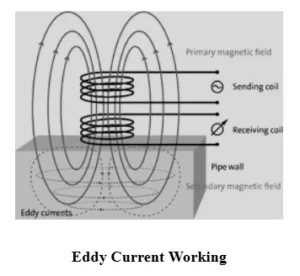
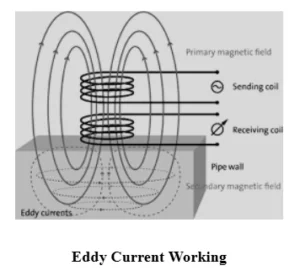
Eddy current testing, or ET, is a non-destructive testing technique for electrically conductive materials. An alternating current drives a coil, which produces a changing magnetic field. Bring that coil near a conductive part and eddy currents form in the material beneath it.
Defects such as cracks, corrosion, and discontinuities disrupt the current flow. That disruption changes the magnetic field and the electrical impedance seen by the coil, and measuring those changes reveals the flaw. The method works quickly and doesn't damage the part, which is why it suits inspection of coated and metal surfaces.
Two newer variants are worth knowing about. Pulsed eddy current testing and eddy current array testing extend the basic technique, and both are used in modern inspection work.
The limitation is physical. Eddy currents concentrate near the surface because of the skin effect, so inspection depth is shallow. Results also depend on material properties, surface condition, and part geometry, so calibration against known reference conditions matters.
Eddy Current Loss in Cores
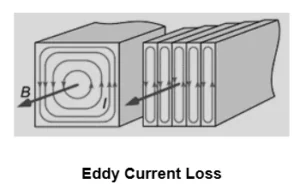
In magnetic materials exposed to a changing field, the circulating currents flow through the material's resistance and dissipate power as heat. That power is eddy current loss. It forms part of the core loss, also called iron loss, in transformers and electrical machines, raising core temperature and lowering efficiency.
In a transformer, alternating flux in the iron core induces EMF throughout the conductive core, and the resulting circulating currents produce the loss. An approximate expression for it is:
Pe = Ke × f² × Bm² × t²
Here Pe is the eddy current loss, Ke is a constant that depends on the core material and its properties, f is the frequency of the magnetic flux, Bm is the maximum flux density, and t is the lamination thickness. The relationship shows loss rising with the square of frequency, the square of maximum flux density, and the square of lamination thickness, under the assumptions of the standard thin-lamination model. That last term is the one designers can control most directly: thinner laminations sharply cut the loss.
Reducing the Loss
Two design approaches dominate. The first is laminated construction. The core is built from thin sheets of magnetic material, each insulated from its neighbours by a coating such as varnish or an oxide film. The insulation interrupts large circulating paths, shrinking the eddy currents and the heat they produce.
The second is material choice. Magnetic materials with higher electrical resistivity, such as silicon steel, restrict circulating current flow and reduce the heat generated in the core. In practice, these two approaches are used together: a resistive alloy in thin, insulated laminations.
Where Eddy Currents Get Used
The same physics appears across a surprisingly wide set of equipment:
- Electric trains: eddy current brakes slow trains without direct frictional contact in certain railway systems.
- PMMC instruments: eddy currents provide damping torque in permanent magnet moving coil meters.
- Energy meters: traditional induction-type meters use eddy currents to produce driving and braking torque.
- Non-destructive testing: detection of cracks, corrosion, and other defects in conductive metal parts.
- Induction heating: heating metal for industrial heating, melting, and surface hardening.
- Mechanical speedometers: eddy currents produce the torque that drives the speed indicator.
- Industrial braking: contactless braking in selected machines and equipment.
Weighing the Trade-Offs
The advantages are clear: contactless braking, fast and non-destructive inspection, and useful torque for metering. Eddy-current-based induction heating and damping are also practical because the effect needs no mechanical linkage.
The disadvantages sit mostly in power equipment. Unwanted heat and energy loss in transformers and machines are the main cost. Magnetic flux leakage can also disturb performance in some electromagnetic systems. On the testing side, the method is limited to conductive materials and shallow depths, and results depend on material and geometry.
My read is that the practical question is rarely "do eddy currents occur?" They always do in a conductor exposed to changing flux. The real question is whether you need to suppress them, as in a transformer core, or harness them, as in a brake or a flaw detector. Get the flux rate, frequency, and conductor resistance right, and the same physics works in either direction.