Haptics Gets a Shared Protocol and a Palm-Sized Drive Module
- Published
- Author
- Max Maxfield
- Reads
- 491
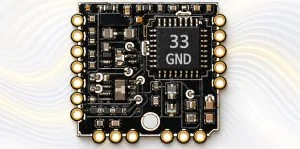
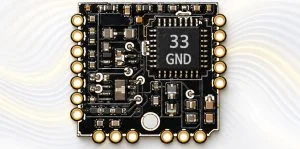
TITAN Haptics' VH Module is the first product to implement the Universal Haptics Protocol 1.0, pairing audio-to-haptics with a primitives-based API.
I expect we'll hear a lot more about haptics soon, and most of it will be about touch-based feedback in products that used to rely only on screens and sound. Before the marketing arrives, it's worth understanding where the technology came from and what has actually changed. The short version: the actuators got much better, and now the software side is catching up.
A word with old roots
"Haptic" comes from the Ancient Greek haptikos, meaning "able to come into contact with" or "pertaining to the sense of touch." In 1685, the English mathematician Isaac Barrow used the Neo-Latin hapticē for the "science of touch." The English adjective appeared in the 19th century, mostly in scientific and medical writing. In 1892, the German psychologist Max Dessoir proposed Haptik for the study of touch, placing it alongside Optik and Akustik.
It helps to separate two ideas here. Passive tactile interfaces convey information through physical features you can feel. Louis Braille's raised-dot system, developed around 1824, is the classic case: it works entirely through touch, but nothing in it moves or pushes back. Active haptic systems do something different. They deliberately generate forces or vibrations, and that distinction is where most of the engineering lives.
Early force feedback, from reactors to cockpits
Deliberate haptic feedback showed up in the 1940s. Engineers at Argonne National Laboratory built remote manipulators for handling radioactive material. Mechanical linkages carried forces back to the operator, so they could feel resistance when the remote gripper touched something. Nothing electronic was involved, but the principle, closing a loop between motion and force, is the same one modern actuators use.
Aviation offers a second early example. In smaller aircraft with mechanically linked controls, a pilot approaching a stall could feel aerodynamic buffeting through the stick. That natural cue wasn't reliable, and powered flight controls in larger aircraft cut the pilot off from those forces almost entirely. Designers responded with stick shakers: systems that monitor conditions including angle of attack and physically vibrate the control column when a stall is imminent. It's a good engineering lesson. When you remove a natural signal, you have to synthesize it, and the synthetic version has to be unmistakable.
From specialist kit to everyday devices
For most of the 20th century, haptics stayed in specialized applications. Computers, video games, virtual reality and mobile devices changed that, and haptics started appearing in ordinary products. Not all of the early attempts worked out.
The Logitech iFeel MouseMan, which appeared around 2000, is a useful case study. Built on technology from Immersion Corporation, it used vibration to signal what the cursor was touching. Crossing a hyperlink or button produced a brief bump, and reaching the edge of a window gave a similar cue. In principle, you could feel your way around a web page without looking at it.
It didn't catch on. The hardware depended on specialized software, and there was no widely adopted standard that let applications and haptic devices talk to each other. Without support from software developers, the device offered little value beyond its novelty, and it faded from the market. The lesson still holds: good hardware is only half the equation. Haptic interfaces need common standards so that hardware and software from different manufacturers can work together. Keep that point in mind, because it comes back later.
When haptics is done well, though, the effect can be convincing. The Home button on an earlier iPhone is a good example. It had no mechanical click. Once the battery ran down, pressing it felt lifeless. With power, the Taptic Engine produced a precisely controlled vibration that made the finger believe something had physically moved.
Eccentric motors versus linear resonant actuators
Making something vibrate is easy. Making it vibrate in the right way, at the right moment, to produce a specific sensation is much harder. For years, the most common approach used an eccentric rotating mass (ERM) motor: a small electric motor with an off-center weight on its shaft. Spinning the motor makes the unbalanced weight shake the whole assembly. That's the buzz of an old pager or the rumble of an early controller. It worked, but it wasn't sophisticated.
The main limitation is inertia. An ERM takes time to spin up and slow down, so short, sharply defined sensations are difficult. There's also a ceiling on expression. A buzz can only communicate so much.
Linear resonant actuators (LRAs) changed the picture. Rather than spinning a weight, an LRA uses electromagnetic force to move a mass back and forth along one axis. Apple's Taptic Engine is a well-known example, and it's convincing enough that a solid-state trackpad can feel as though it has a mechanical switch underneath.
Even so, conventional LRAs struggle across a broad range of frequencies. That's the gap TITAN Haptics is targeting.
TITAN's approach to the actuator problem
I spoke with Tim Szeto, founder and CEO of TITAN Haptics. The company is based in Toronto, Canada, and was incorporated in 2021, although its underlying technology came out of a Silicon Valley research laboratory several years earlier. Its Linear Magnetic Ram (LMR) actuators differ from traditional resonant designs in one key way: they use a magnetic suspension system instead of mechanical springs. According to TITAN, that lets them respond across a much wider frequency range, which opens up richer tactile effects.
Szeto's mental model is a loudspeaker. A haptic actuator is mechanically coupled to a device, the way a speaker cone couples to air, except the goal is sensation you feel rather than sound you hear. That framing matters for designers. A speaker engineer thinks about bandwidth, transient response and distortion. A haptics engineer now has to think about those same things, because a wide, controllable response is what allows distinct sensations rather than a generic buzz.
The applications that follow from that are concrete. A game controller could reproduce light rain, the rumble of a vehicle, or the kick of a shot. A touchscreen could produce a convincing click even though nothing moves beneath the glass.
The control problem
Here's the thing: a capable actuator doesn't make it easy to tell it what to do. Historically, every manufacturer has described, generated and controlled haptic effects in its own way. That's manageable inside one product line. It becomes a real burden for designers who want consistent tactile behavior across different devices and platforms.
That's the problem the Universal Haptics Protocol (UHP) 1.0 specification is meant to solve. The Haptics Industry Forum (HIF), whose members include Logitech and iRacing, developed it. TITAN is also an HIF member, and Szeto chairs the working group responsible for the protocol. According to the announcement, UHP 1.0 was published in September 2026. It provides a common vocabulary for describing haptic effects, identifying device capabilities, routing effects to the right actuators and controlling playback. The idea is a shared foundation, so every vendor doesn't have to reinvent the same layer.
TITAN's VH Module is described as the first product on the market to implement the UHP 1.0 specification.
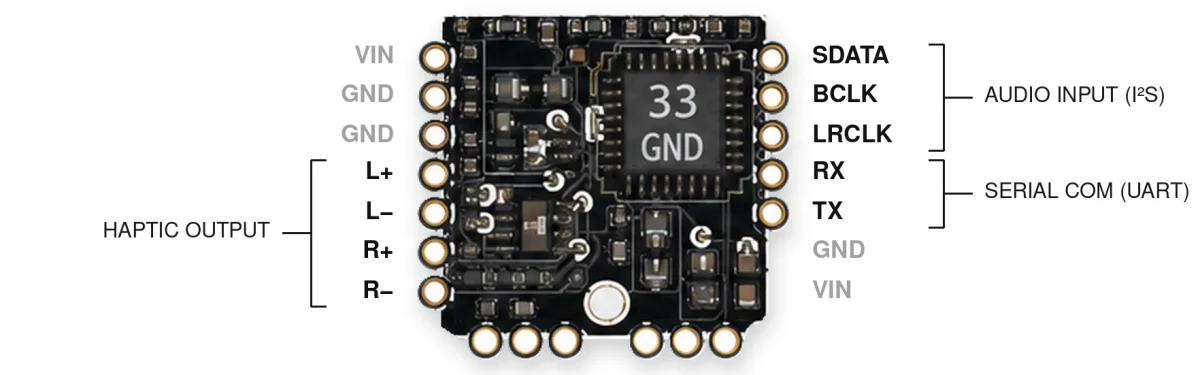
VH Module (Source: TITAN Haptics)
What the VH Module actually is
The VH Module measures 10.8 × 10.8 mm and is described as a complete embedded haptic processing and drive subsystem. It doesn't vibrate anything itself. Its job is to generate and amplify the electrical signals that drive external actuators, including TITAN's wideband LMR devices.
Specifications from TITAN include onboard digital signal processing (DSP), two independently controlled actuator channels, and up to 3 W per channel under specified operating conditions. The host microcontroller communicates over a serial UART, and an I²S interface accepts digital audio. Those interfaces matter for integration. A UART link means a modest host processor can drive the module, and I²S means the module can sit in an audio path rather than requiring a separate signal chain.
The module's most practical feature is audio-to-haptics. A game already produces audio for explosions, engines and impacts. Rather than authoring a second set of haptic effects, a developer can feed the existing digital audio stream into the VH Module, which converts it to tactile output in real time. The DSP can filter and equalize that input, so you can shape the result and keep speech or background noise from buzzing the controller.
Primitives and the API
Audio-to-haptics only covers part of the job. For deliberate, authored effects, TITAN offers its Vector Haptics API. Developers build effects from primitives: pulses, ticks, vibrations, pauses and frequency sweeps. Parameters such as duration, intensity, frequency and sharpness define how each effect feels. Szeto compares these to LEGO bricks. You combine simple parts rather than picking from a fixed library of prerecorded vibrations.
This approach also keeps data small. Instead of storing a full sampled waveform, the host microcontroller stores a compact description of the effect and sends it to the module, which synthesizes the waveform. For resource-constrained controllers and wearables, that trade is significant.
The two methods don't conflict. The VH Module can mix audio-derived sensations with API-generated effects in real time, so several can overlap. Picture a spaceflight game. Audio-to-haptics produces a continuous low rumble from the engines. The API adds a sharp click when you press a control and a stronger jolt when an enemy projectile hits. Two independent channels let you route different sensations to different actuators, so the rumble can come from one side of the controller and the jolt from the other.
The appeal is integration. TITAN has packaged the processor, signal-processing algorithms, amplifier and control interface into one small module. Without that, a developer would assemble those pieces from separate parts and proprietary control schemes.
Design judgment still matters
Szeto made a point that's easy to overlook: compelling haptics is closer to an art form than a specification sheet. Like music, the goal isn't maximum intensity. Subtlety, timing and contrast are what make the sensation believable. A system with a wide bandwidth and two channels still needs careful tuning to avoid a constant, fatiguing buzz. Protocols and modules reduce the friction of implementation, but they don't write the effects for you.
The applications go beyond games. AR and VR headsets, automotive controls, wearables, medical equipment and computer mice are all plausible targets. A mouse that gives tactile feedback as you navigate menus, drag objects or resize windows is essentially the iFeel MouseMan idea, revisited with better actuators and, potentially, a standard to build on.
Looking back, the iFeel MouseMan failed for reasons that had little to do with the actuator. The missing pieces were software support and a shared standard. UHP 1.0 targets exactly that gap. Whether it gains enough adoption to matter will depend on whether other vendors implement it and whether developers write effects against it. My read is that the next year or two will show whether this becomes a real industry layer or stays a specification on paper. Either way, the hardware is ready, and the question now is who builds the software that makes people want to feel their way around the interface.


