Flash Memory Compute Could Bring Adaptive AI to Subwatt Edge Devices
- Published
- Author
- Max Maxfield
- Reads
- 380
SST’s memBrain performs neural network calculations inside flash memory; AnalogAI aims to pair it with on-device adaptation at one watt or less.


Putting computation inside flash memory changes the energy equation for edge AI: processors can avoid repeatedly moving neural network data between memory and separate arithmetic units. Silicon Storage Technology’s memBrain SAGE IP uses that approach, and South Korean processor developer AnalogAI plans to combine it with algorithms intended to let devices adapt after deployment. The company is targeting power consumption of one watt or less.

The distinction matters for machines that must make decisions locally, where power and connectivity are constrained. Robots, industrial equipment, vehicles and other edge systems could benefit if they can run inference and adjust to changing conditions without depending on a remote server. AnalogAI’s processors are still in development, so the potential is clearer than the eventual product performance.
Calculations inside the memory array
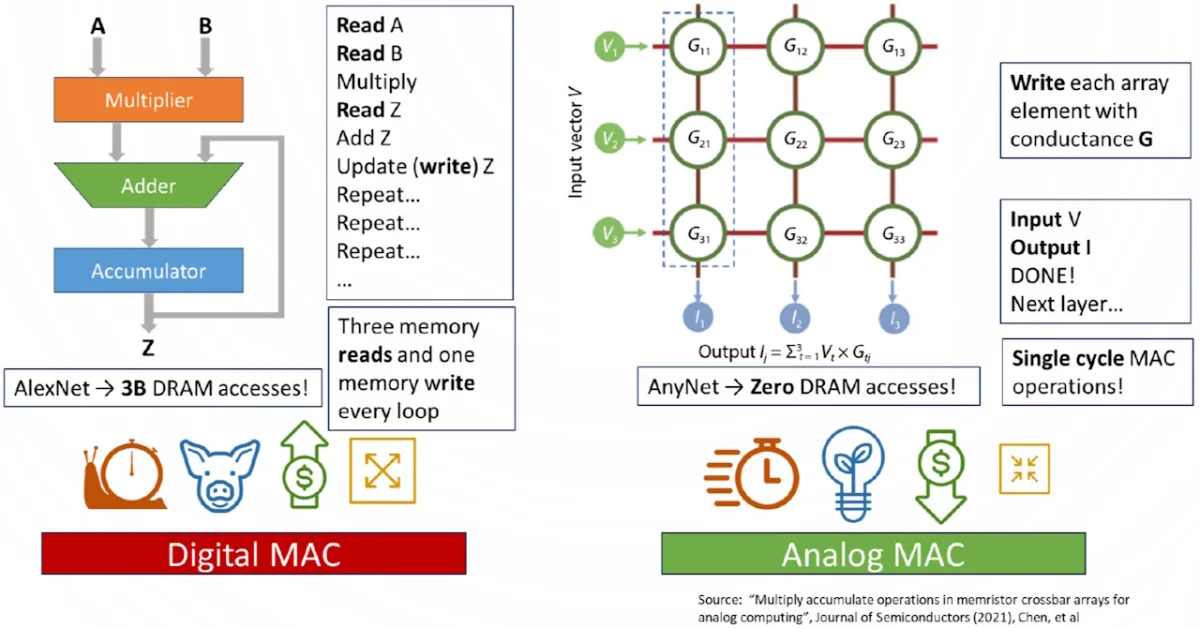
Neural networks rely heavily on multiply-accumulate operations, or MACs: values are multiplied and the products added to a running total. In a conventional digital system, arithmetic circuitry performs those operations using values fetched from memory. GPUs can execute many MACs in parallel, but transferring data between memory and processing elements takes time and energy.
MemBrain instead uses the memory cells themselves to represent neural network weights and carry out parts of the computation. Its foundation is SST’s embedded SuperFlash technology. The cells are programmed to represent analog values rather than serving only as storage for binary ones and zeros.
According to David Eggleston, Associate Director of Business Development at Microchip Licensing Division, each cell can represent one of 32 levels, or five bits. Those levels correspond to electrical conductance, the inverse of resistance. Applying a voltage produces a current proportional to the voltage and conductance, so the cell’s physical behavior performs a multiplication.
Arrange cells in an array and apply input voltages to multiple rows at once, and currents add along the columns. That provides the accumulation part of the MAC operation. The array can therefore perform multiple operations in parallel without sending every value to a separate digital arithmetic unit.
MemBrain is a licensable IP package for incorporation into application-specific integrated circuits and systems-on-chip. Alongside SuperFlash arrays, it includes analog control circuitry, digital-to-analog and analog-to-digital converters, simulation models, test programs, and software tools for preparing and loading neural network models. That surrounding circuitry and software matter: integrating compute-in-memory requires a way to translate between digital inputs, analog operations and usable outputs.
The technology has been developed for established 40nm and 28nm foundry processes, rather than requiring a new manufacturing process. SST also runs the cells at currents ranging from 1 to 100 nanoamps, Eggleston said, compared with 10 microamps or more for a conventional flash memory read. Achieving those low currents involves operating transistors in the subthreshold region, which takes specialized design work.
Efficiency depends on the workload
SST provided a comparison using a YOLOv5 neural network for video-based threat detection. Its GPU system processed 200 frames per second while consuming 60 watts. The analog compute-in-memory system processed 150 frames per second at 3 watts.
On those figures, the aCIM system delivered 50 frames per second per watt, against about 3.33 for the GPU: roughly 15 times the energy efficiency in this particular comparison. It also ran at a lower frame rate, and SST’s figures indicate a reduction in silicon die cost. These are vendor-supplied results for one workload, not a general performance ranking. GPUs remain suited to large models, flexible workloads and high throughput; the appeal of compute-in-memory is strongest where energy use constrains what can run at the edge.
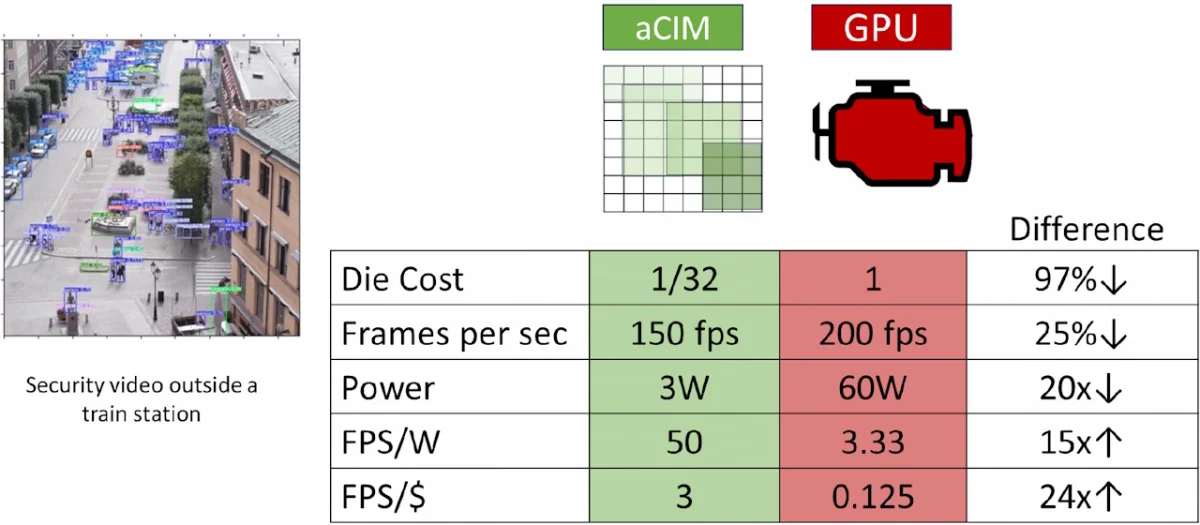
aCIM and GPU performance figures supplied by Microchip
Adding adaptation at the edge
Most deployed AI systems run models trained elsewhere. AnalogAI’s plan goes a step further: combine memBrain SAGE with proprietary, hardware-aware algorithms so a processor can perform inference while adapting to real-world changes. The company points to conditions such as unfamiliar surroundings for a robot or changing light and weather for a drone. Local adaptation could reduce reliance on cloud access, though the company’s target and approach do not yet establish how well a finished processor will perform.
That combination is distinct from low-power inference alone. A fixed model can make predictions on-device, but adapting its behavior after deployment adds another demand on the processor and its memory. AnalogAI is aiming to handle both within one watt or less. The target places a tight budget on the design; the practical result will depend on the algorithms, model and workload, details not provided here.
The intended range extends beyond robots and drones to autonomous vehicles and industrial machines. Such equipment often needs local decisions and may not have reliable access to a remote server. In these settings, the engineering question is whether a device can make useful adaptations within its power and compute limits, rather than whether it can match a large GPU on every task.
A growing set of licensees and products
AnalogAI is the fourth publicly announced licensee of memBrain, according to Eggleston. Earlier adopters include Witmem, which selected the technology for low-power speech processing in February 2022, and Intelligent Hardware Korea, which announced work on analog compute platforms for edge AI, particularly computer vision, in September 2023.
In October 2024, GlobalFoundries, Witmem and Microchip announced sampling of Witmem’s WTM-8 video processor, specified for 8K video at 120 frames per second. Mythic announced in March 2026 that it had selected memBrain for its next generation of ultra-low-power analog processing units. AnalogAI’s selection followed in September 2026.
There is also a consumer product example. Anker’s Soundcore Liberty 5 Pro and Liberty 5 Pro Max earbuds use the THUS AI audio chip, a co-developed processor that performs AI computations locally. Eggleston said Witmem supplies the underlying silicon incorporating SST’s memBrain technology. The example shows the architecture reaching a product category where local audio processing can operate without a cloud connection.
Microchip and SST identify possible uses including smart speakers, security cameras, augmented-reality glasses, medical devices, autonomous drones and industrial robots. These applications differ, but share a constraint: they need local computation without the energy budget associated with conventional AI workloads. MemBrain’s established process nodes and low cell currents may help address that constraint, while the ecosystem of licensees points to multiple implementations rather than a single standard processor.
For engineers, the key development to watch is how these implementations balance inference performance, adaptation, power and integration effort in actual products. Compute-in-memory offers a physical way to cut data movement; AnalogAI’s work tests whether that efficiency can also support systems that learn from conditions on the job.


