IMI's Printed Nickel Alloy Valve Trims Qualify for Sour-Gas Service
- Published
- Author
- Paloma Duran
- Reads
- 753
IMI's laser powder bed fusion disk stacks passed DNV-ST-B203 AMC Level 3 and are now running in H₂S-exposed anti-surge valves at TotalEnergies EP Denmark.
The headline result is simple: seven anti-surge valves at TotalEnergies EP Denmark now run with additively manufactured nickel-based alloy disk stacks from IMI, in a sour-gas environment where hydrogen sulphide partial pressures reach up to 3.3 kPa. What makes this worth a closer look is the path to approval. Printed metal parts in sour service have been a hard sell, and this one cleared the qualification bar rather than getting a special exemption.
Why this valve problem was hard to fix
Anti-surge valves protect centrifugal compressors by opening a recycle path when flow drops toward the surge line, and they have to seal reliably when they're needed. The operating problem at this site was valve passing, meaning leakage through a closed valve, in anti-surge systems working under demanding service conditions. Passing matters here because a valve that doesn't seal properly can't do its protective job, and in H₂S service the material has to survive corrosion as well as mechanical load.
That combination is what made replacement difficult to approve. Any new component had to demonstrate high corrosion resistance, reliability and mechanical performance before it could be cleared. Nickel-based alloys are a common choice across oil and gas for exactly this reason. The catch is that conventionally manufactured alloy parts come with decades of field history, while additively manufactured versions in sour service have very little. So the project couldn't rely on prior experience. It had to be qualified from the ground up.
Qualifying a printed part for sour service
IMI's engineering team worked with TotalEnergies to develop and validate the printed disk stacks. The disks were produced by laser powder bed fusion (LPBF). IMI also developed a proprietary heat treatment aimed at sour-service conditions, and the program paired extensive mechanical and corrosion testing with that treatment. The stated goal of the heat treatment was to draw the best material performance out of the alloy, and the printed parts were then assessed against DNV-ST-B203 AMC Level 3.
Test results, as IMI and TotalEnergies describe them, showed the printed parts performing as well as conventionally manufactured nickel-alloy components while meeting the requirements of that qualification. TotalEnergies then approved the installation of the seven valves. My read is that the heat treatment is the detail engineers should focus on. In LPBF nickel alloys, as-built microstructure and residual stress can differ from wrought or cast material, so a post-build treatment tuned for the corrosive service is usually the lever that brings the properties back into line. Whether a given alloy and process combination reaches that point depends heavily on the test program, which is why the qualification record matters more than the printing technology itself.
Bertrand Maillon, Retrofit3D leader at IMI, framed the work as a test of reliability rather than printability. In his words, the challenge was to avoid simply producing an additively manufactured component, and instead to demonstrate that it could perform reliably in a demanding sour-gas environment where corrosion resistance and long-term integrity are critical. He described the first valves entering service as an important milestone for both companies, and credited the result to the qualification program, the heat treatment the two teams developed together, and close engineering collaboration.
Bertrand Levaché, Head of Additive Manufacturing at TotalEnergies, described the project as having grown from a joint effort to solve valve reliability problems in a demanding H₂S environment into a practical demonstration of what innovation can achieve when two organisations work closely together.

What the Retrofit3D trims actually change
The disk stacks come from IMI's Retrofit3D program, which designs custom 3D printed control valve trims that fit into existing valve bodies. The trims use IMI's DRAG technology, which routes fluid through a multi-stage, multi-path trim to reduce differential pressure across the valve. IMI says the design eliminates erosion, vibration and noise. Depending on the problem, the company replaces either the cage alone or the full trim set.
The retrofit logic is the part I find most interesting for plant engineers. Only the internal trim changes. The pressure boundary and the actuation stay untouched, which IMI says lowers the risk for the operator. Because no pipework is cut or re-welded, the company states that installation can be completed within hours. That's a very different proposition from replacing a welded valve assembly, which typically means shutdown work, weld procedures and re-inspection of the joints. If the trim is the only thing that wears out or underperforms, changing just the trim keeps the rest of the installed hardware in service.
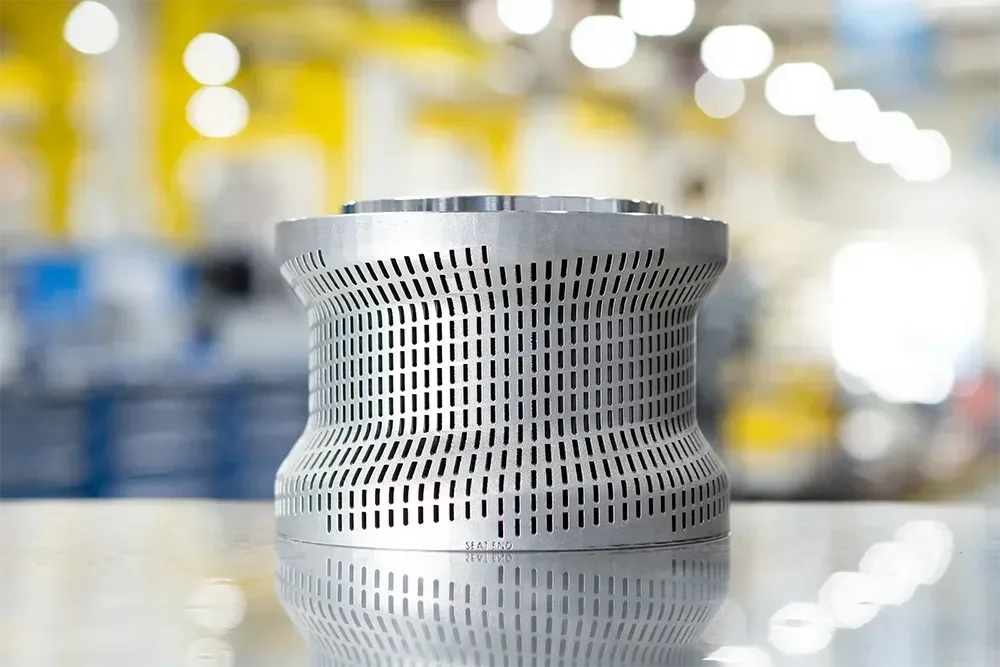
IMI says the TotalEnergies project is part of its broader Retrofit3D strategy of fixing control valves by replacing internal parts, so welded valves don't have to be cut out and swapped. The company says it has upgraded hundreds of valves this way, including projects in China and for Griffith Energy. The sour-service qualification extends that approach into a corrosive environment where the original trim material would have been the natural weak point.
A wider pattern in oil and gas
This isn't an isolated experiment. Operators are increasingly turning to 3D printing to keep existing equipment running. ConocoPhillips identified the need to replace many of its choke cage valves, which control water flow in oilfield injection wells. With the OEM no longer making the parts, the company retrofitted its existing valves with 3D printed cages, which it says extended valve life, reduced costs and improved uptime. Shell has gone further into pressure-bearing hardware, receiving CE certification from LRQA for a 3D printed pressure vessel at a time when no standards existed specifically for printed pressure-retaining parts.
Qualification has been the common thread across these cases. DNV GL organised two Joint Innovation Projects with 20 partners, including BP, Shell, Total (now TotalEnergies), Siemens and SLM Solutions, to develop guidelines for qualifying parts made by LPBF and WAAM. On the supplier side, Protolabs was reported to be the first powder bed fusion manufacturer certified by DNV for oil and gas, with that certification covering its DMLS process with Inconel 718. IMI's project adds a printed part qualified to DNV-ST-B203 AMC Level 3 and now running inside sour-gas valves, which moves the conversation from whether printed parts can be qualified for this work to how many more components can follow the same route.
What to watch next
For engineers evaluating printed trims, the practical questions are about scope and repeatability. Qualification here applies to a specific alloy, process route and heat treatment, and any change to powder, build parameters or post-processing would need to be considered against that record. The seven-valve deployment is also an early data set. Long-term behaviour under H₂S exposure, including corrosion and integrity over service life, will be what determines whether printed trims become a standard option rather than a one-off project. The next useful signal is likely to be more operators citing the same qualification basis for their own valve populations.


