GEFERTEC to Show 700 kg WAAM Impeller and Titanium System at Formnext 2026
- Published
- Author
- Aura Moreno
- Reads
- 713
GEFERTEC will exhibit large WAAM components and preview modular, titanium-focused and containerized production systems in Frankfurt.

A 700 kg compressor impeller puts a practical question at the centre of GEFERTEC’s Formnext 2026 exhibit: where can wire arc additive manufacturing (WAAM) make large metal parts that conventional routes struggle to produce? The German company plans to show the impeller alongside a fish-friendly seawater pump impeller, a titanium aircraft emergency exit frame and a tooling mold. Its stand will also feature two machine systems introduced this year and a preview of a containerized unit for production on site.

Formnext takes place in Frankfurt from November 17 to 20. GEFERTEC will exhibit at the Berlin-Brandenburg joint booth in Hall 12.1, Booth B101. The company’s display is aimed at showing the range of shapes and component sizes it says WAAM can produce, including parts that casting or machining handle with difficulty or cannot make at all.
Large parts and demanding shapes
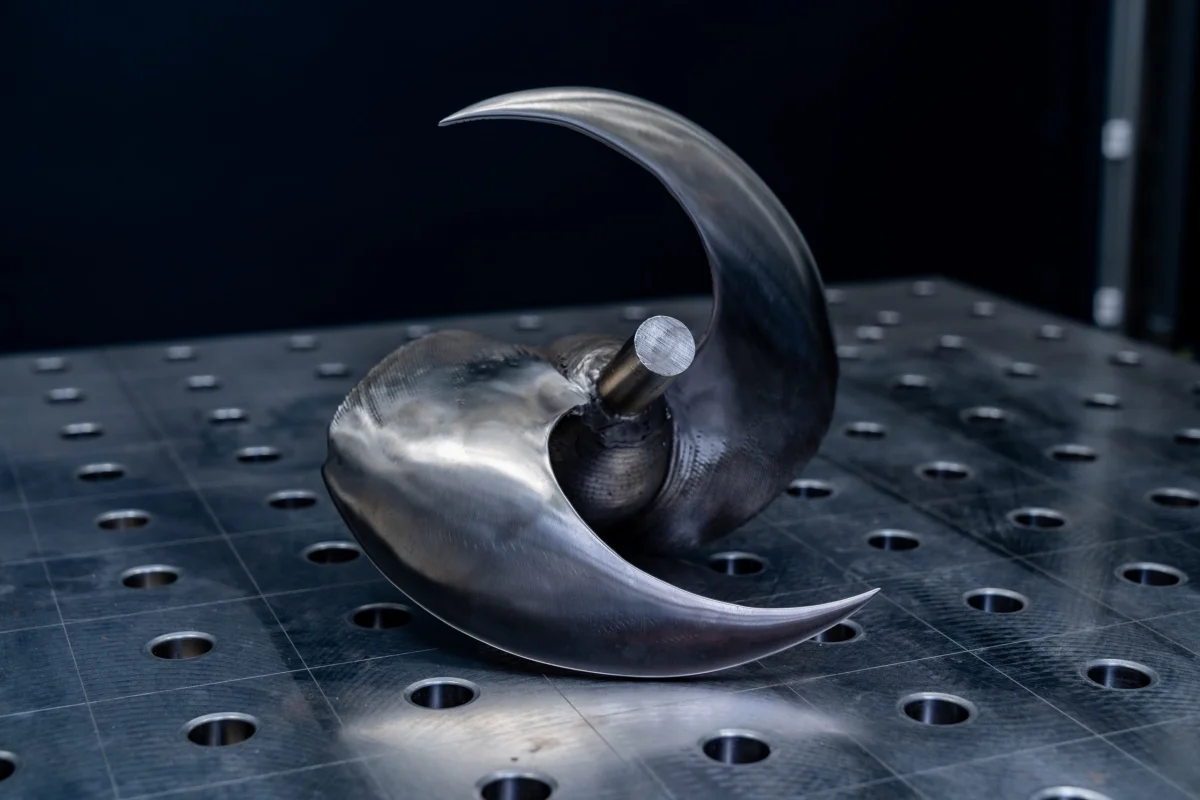
The seawater pump impeller will be shown publicly for the first time. Its long, wing-shaped blades are designed to let fish pass through the pump unharmed after being drawn in. GEFERTEC says the geometry cannot be produced by conventional casting. The shape is the point: the company is presenting WAAM as a way to build functional features that may be difficult to realize through established forming and material-removal processes.
The other exhibits point to different industrial uses. The compressor impeller demonstrates scale, while the titanium aircraft frame represents an aerospace application and the tooling mold illustrates use in production tooling. Taken together, the components offer visitors a way to compare WAAM’s potential across energy, aerospace and tooling, rather than judging the process from a machine specification alone.
GEFERTEC says WAAM can reduce material use and lead times, and can produce improved material properties. Those are company claims; the details provided for the exhibit do not include comparative figures, test conditions or part-specific measurements. For engineering teams assessing the process, the key questions will be how the deposited material performs in the intended application, what finishing or inspection the part requires, and whether the production route fits the component’s geometry and volume.
Two systems for different production needs
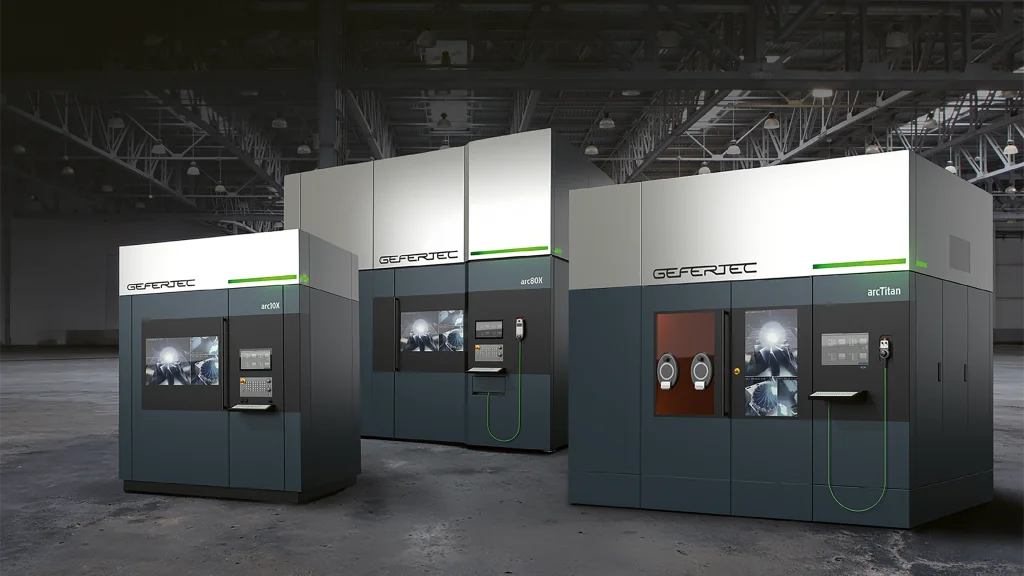
The arc10X is one of the new systems GEFERTEC plans to present. Its modular layout is intended to let manufacturers integrate it into existing production environments. The system sits alongside the company’s established arc80X platform, which is designed for component volumes up to 8 m³. The distinction matters for teams weighing a WAAM cell against their available floor space, production flow and part envelope: the arc10X is presented around integration, while the arc80X is specified for large component volumes.
The arcTitan is built specifically for titanium. Titanium reacts readily with oxygen at elevated temperatures, so controlling the atmosphere during deposition is central to process repeatability. GEFERTEC pairs a plasma-based WAAM process with a fully sealed inert gas atmosphere. When the company launched the system in August, it said gas management, sensors, wire feeding and parameter control had been developed around titanium processing. It reported an oxygen level of 10 to 15 ppm throughout a build.
That oxygen figure is a stated process condition, not a general performance guarantee for every part or operating setup. Johannes Zuckschwerdt, GEFERTEC’s managing director, described reproducible process conditions as the main challenge in additive manufacturing of titanium. For prospective users, the machine’s material-specific controls and the conditions they maintain through a complete build are central details to examine alongside component quality.
WAAM beyond a fixed production cell
GEFERTEC will also preview a containerized system intended to carry out metal additive manufacturing on site. The concept shifts attention from the machine alone to where production happens. A mobile installation could be useful where large components are awkward to move, though the company has not provided deployment times, operating specifications or availability details for its preview unit.
Containerized WAAM and titanium-focused deposition have precedents. Austrian welding systems maker SBI Produktion introduced the M3DP in 2019, a plasma arc directed energy deposition machine with an enclosure that creates an inert atmosphere for reactive metals such as titanium and nickel-based alloys. SBI cited deposition rates up to 10 kg/h with steel. That rate is specific to the material and system conditions SBI described; it should not be treated as a titanium production figure or a direct comparison with GEFERTEC’s equipment.
GEFERTEC supplies complete WAAM systems that adapt gas metal arc welding for additive buildup. Its package includes integrated CAM software and in-process quality assurance. The company is a wholly owned subsidiary of Berlin.Industrial.Group, a Berlin-based group with around 360 employees.
Sebastian Recke, GEFERTEC’s Senior Key Account Manager, said the company wants visitors to see what the technology can build, from large structural parts to complex geometries and titanium components. The exhibit’s value will rest on those physical examples and the production details GEFERTEC can provide alongside them. For manufacturers, the practical takeaway is to assess each application against its geometry, material controls, required quality checks and production setting before deciding whether WAAM fits the job.