Young Makers in Hyderabad Combine Computer Vision, Sensors and Moving Hardware
- Published
- Author
- Anuj Alphonson
- Reads
- 392
Coolest Projects India showcased 132 projects from 326 young creators, including camera-driven music, motion-tracked therapy and a physical arcade game.
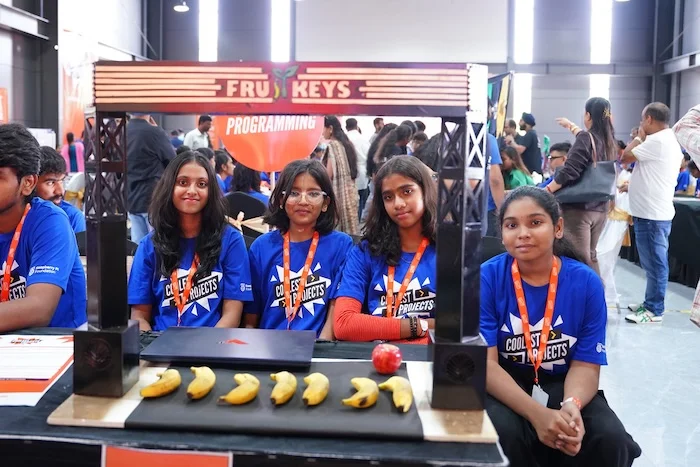
Camera vision, wearable sensing and motorised mechanisms all featured in projects presented by young makers at Coolest Projects India in Hyderabad. The event returned for its second year on Saturday, 19 September, bringing together 326 creators to show 132 projects spanning artificial intelligence, hardware and web development.
The range matters as much as the project count. These teams used technology to make familiar activities interactive: playing music, practising physical therapy and navigating an arcade game. Their builds also show how a camera or sensor can serve as an input device, translating movement or an object in view into a response from software or hardware.
Fruit becomes a camera-tracked instrument
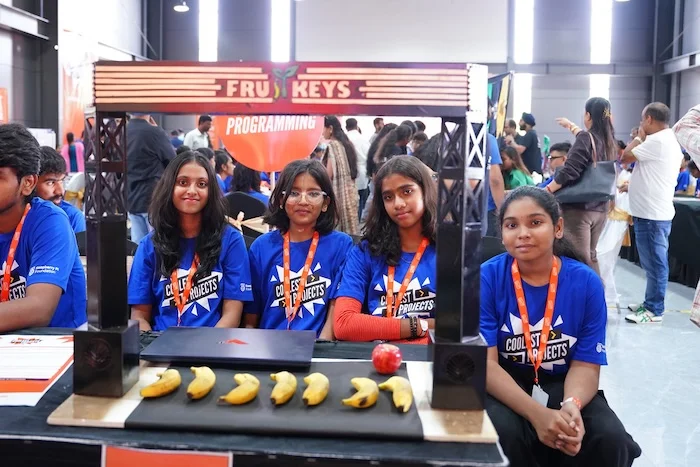
Vhedhya, Tanvi, Bhavani and Sameeksha built Fruit keys, a musical interface that uses bananas as virtual keys and an apple to switch between instrument sounds. Their system combines a Raspberry Pi computer, a camera and the OpenCV software library to recognise what is in view and trigger a corresponding musical response.
The design replaces physical keys with visual input. That makes the fruit part of the interface rather than simply a prop: the camera supplies observations, while software maps those observations to notes or a change in sound. The project illustrates a useful pattern for interactive computing, in which a camera can provide control without requiring a conventional button or keyboard for every action.
There are practical design questions behind that simple interaction. A camera-based instrument needs to distinguish the objects it is meant to recognise and associate each one with the intended output. The project description doesn’t specify how the team handled lighting, camera position or recognition errors, so its operating limits aren’t known. Still, the basic arrangement makes computer vision tangible: an object enters the camera’s view, software identifies it, and the computer produces sound.
Movement tracking meets home therapy
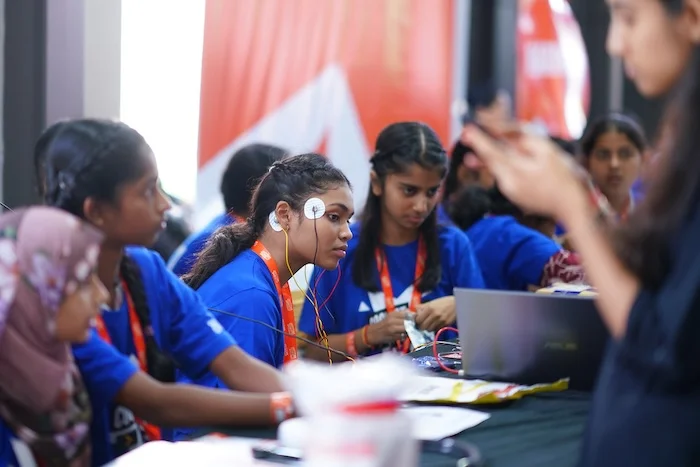
Kumari, Bhoomika and Shaurya presented Kinetic care, a proposed home physical therapy system built around motion tracking and a wearable sensor. A camera follows the user’s movements as they play a video game based on therapy exercises. The wearable monitors for sudden or unsafe muscle movements and provides a vibration alert when it detects one.
That combination gives the project two kinds of feedback. The game offers a visual task during exercise, while the wearable provides a direct tactile warning if it detects a movement the system flags. In principle, the camera and sensor divide the work between tracking activity and alerting the user. The description doesn’t identify the sensor type, explain how unsafe movement is defined, or give accuracy or validation results, so the build should be understood as a project demonstration rather than evidence of clinical performance.
Even at a prototype level, the design points to a real engineering challenge in interactive rehabilitation: useful feedback has to arrive while a person is moving, and it has to be clear enough to act on. A vibration can communicate an alert without asking the user to look away from the exercise, while a game can give the session a defined task. Whether those features suit a particular therapy routine depends on the exercise and the advice of the person overseeing it; the project description doesn’t provide treatment guidance.
A physical game makes the mechanism visible
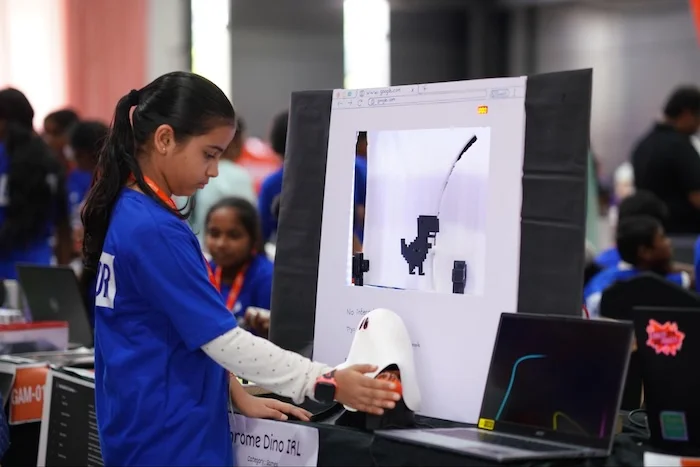
Srishti and Kimaya’s Chrome dino in real life translates a familiar screen game into a physical arcade-style build. A motorised conveyor moves obstacles, and players use a button to dodge them. LEDs and sound effects add feedback, while the game becomes harder as it progresses. High scores unlock rewards.
Unlike the camera-led projects, this game makes the moving mechanism part of play. The conveyor supplies continuous motion; the button gives the player a clear control input; and the lights and sound signal what the game is doing. Those pieces have to work together for the challenge to feel responsive. The description gives no details about the motor, conveyor speed or obstacle sensing, so the implementation’s exact control scheme and performance can’t be assessed.
That visible motion is part of the appeal for makers: software rules become something a player can watch and react to. It also creates a different set of design considerations from a screen-only game, since moving obstacles and a motorised belt must be coordinated with the player’s input and the game’s changing difficulty.
What the showcase demonstrates
Across the three examples, the core engineering move is mapping an input to an outcome. A camera recognises fruit and triggers sound; a camera and wearable sensor observe exercise and provide feedback; a button controls a physical game with moving obstacles. Each project joins software to something a participant can see, hear, feel or manipulate.
The event’s 132 projects covered more than these examples, but the details available here show how young creators approached playful and practical ideas with accessible computing, sensors and hardware. The builds invite the next engineering questions: how reliably does the system detect its input, how does it behave when that input is ambiguous, and what feedback helps a user understand the response?
Coolest Projects India’s second year in Hyderabad gave 326 young technology creators a place to present their work. For the teams, explaining a working idea to other people is part of the engineering process: it makes the choices visible and gives the next iteration somewhere to start.