Electric Motors on a Shared Backbone Mimic Muscle Coordination
- Published
- Author
- The Conversation
- Reads
- 443
Bristol researchers built a tabletop array of electric motors that self-coordinates like muscle, suggesting simpler control strategies for robot actuators.
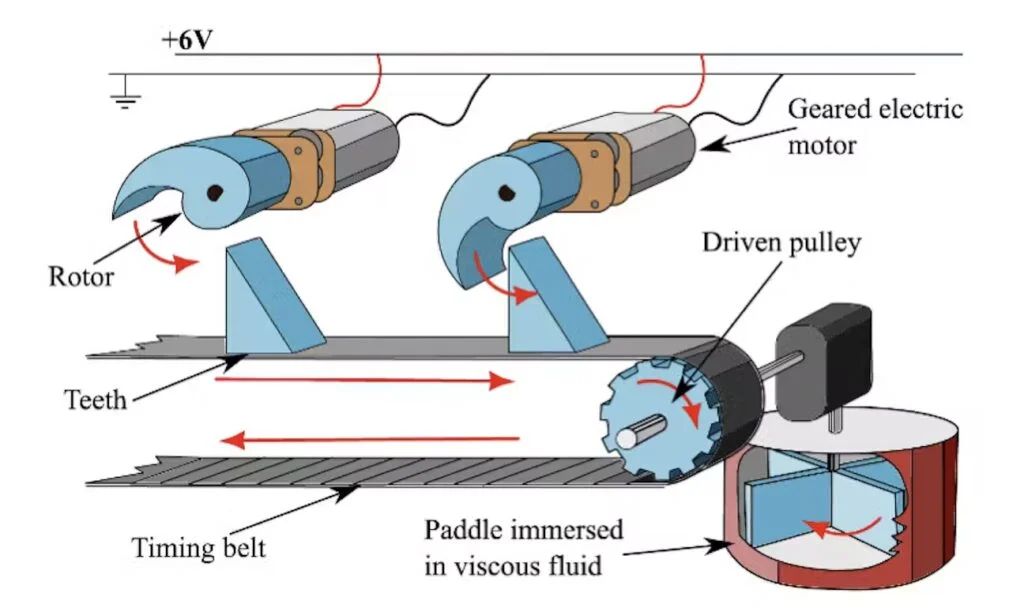
Most robot actuator design starts from the assumption that many motors need a controller telling each one what to do. A University of Bristol team has tested a different idea: that the coordination seen in real muscle can emerge from the physical setup alone. Their model, published in the Royal Society journal Interface, uses a line of ordinary electric motors and a shared mechanical backbone. Under load, the array settles into behaviour that looks a lot like muscle.
What muscle actually does
Muscle turns chemical energy into movement, and it does so with a surprising amount of grace. Pick up a bag, hold a cup of coffee, or climb a hill, and the body adjusts force, speed and position without conscious effort. The mechanism underneath is less settled than the output suggests.
The sarcomere is the key force-producing unit. Its actin filaments and myosin molecular motors together form the actomyosin system. Myosin motors repeatedly grab, pull and release actin, and in a muscle fibre, thousands of them have to act together to produce a steady force. The Bristol team didn't try to reproduce the biochemistry of that cycle. They asked a narrower question: what does the mechanical arrangement contribute?
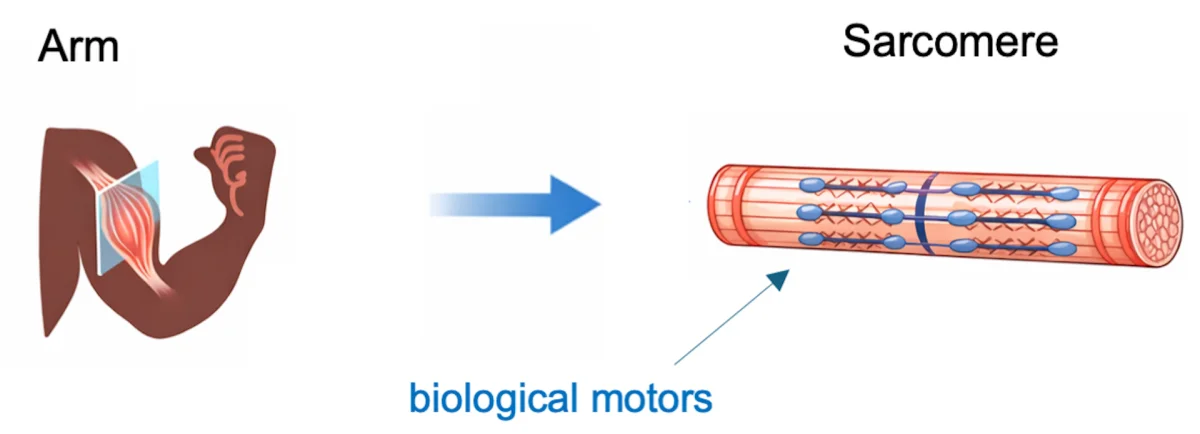 Illustration showing the smallest functional unit of muscle: the sarcomere.
Stripping the model down
The mathematical model represents each force-producing unit as a cycling rotor, or motor, that contributes only when it is mechanically engaged with a physical backbone. When it disengages, it drops out and becomes isolated from its neighbours. That on-off engagement is the design choice that matters most.
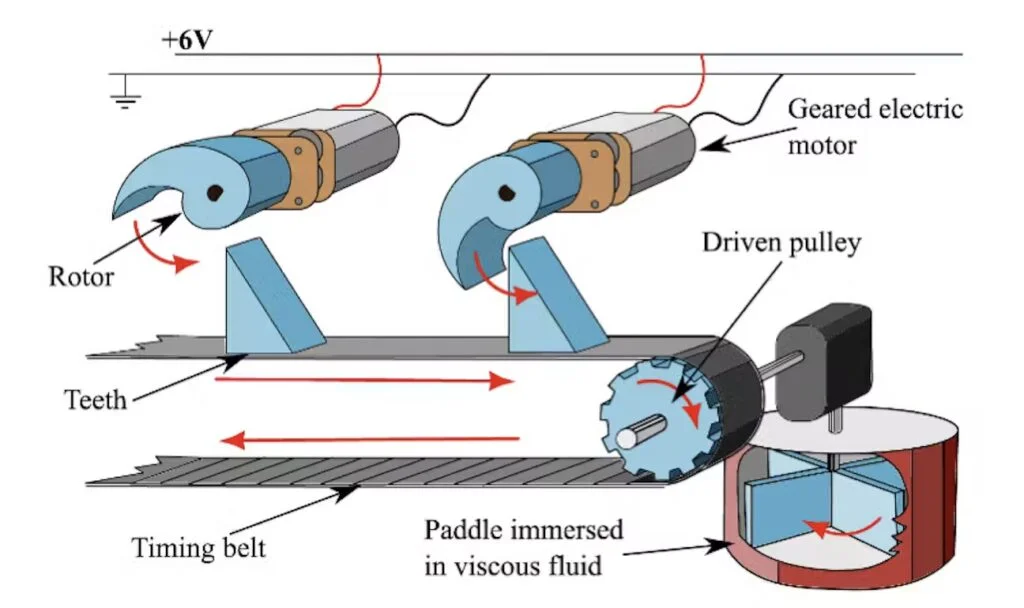
To test whether the idea holds in hardware, the team built a tabletop device. A line of simple electric motors interacts through a shared backbone and pulls against a thick fluid, which provides resistance similar to the viscous load that biological motors feel inside muscle. Supplied with current, each motor produces force. The open question was whether enough of these units, embedded in the right mechanical setting, would organise into coordinated behaviour.
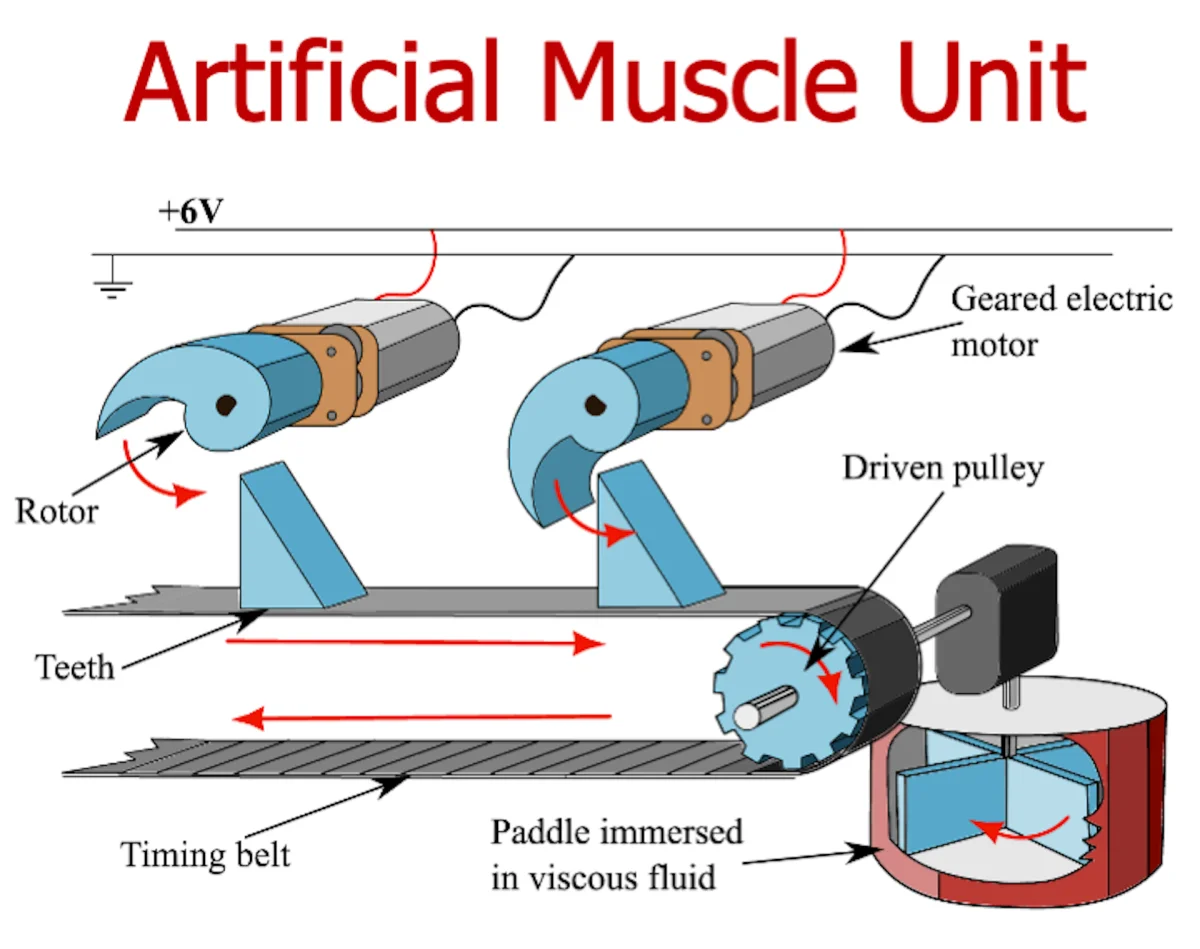 An illustration of the artificial muscle unit used in the study.
Here's the thing: the motors never communicate directly. Each one briefly contacts the moving backbone, pushes on it, then lets go. As the backbone moves, it carries the mechanical effect of one motor to the next. Coordination travels through the structure, not through a control signal. When motors are disconnected, they act independently, and that intermittent attachment is what lets the whole network reorganise over time. Real motors attach and detach as part of their biochemical cycles, so the parallel is direct.
Muscle-like behaviour without programming
Even in this stripped-down system, several recognisable muscle behaviours appeared without being programmed in. As resistance increased, the motors collectively developed a load-speed relationship, a trait familiar from real muscle physiology. Load here means the mechanical tension and stress placed on the system.
More units contributed effectively as the load rose, so participation scaled with demand. Under some conditions, motion became jerky. Periods of coordinated pulling were interrupted by sudden slips, which the authors note echoes patterns seen in actomyosin experiments. And rather than moving in unison, the array sometimes self-organised into travelling waves of coordination that move along the line.
That last behaviour is worth dwelling on. In loose terms, the device scales up the sarcomere's core idea: many force units embedded in a shared structure that transmits forces from one unit to the next. The scaffold, not a central controller, is doing much of the organising, and it does so mostly out of sight.
Nature has done this before
Muscle isn't the only biological system where many small motors coordinate. Flagella and cilia on eukaryotic cells, including the tail of human sperm, are powered by large numbers of molecular motors arranged along a slender scaffold. Their internal core, the axoneme, transmits force along its length and converts local motor activity into bending waves. Those waves drive sperm motility and move fluid in the airways, with clear links to health and disease.
Bending waves caused by motor contraction in sperm swimming.
Seen this way, flagella are muscle-like systems in disguise: drivers embedded in a coupling structure that transmits force and feedback, with geometry determining how local activity adds up to a coherent travelling wave. If structure and layout are doing real organising work in these systems, that raises a broader question about how evolution builds reliable, adaptive assemblies of many motors without a central control system.
What this could mean for robots
The practical stakes are in robotics. Getting many actuators, the "muscles" that convert an energy source such as electricity into motion, to cooperate is hard. Designers typically add sensors, feedback loops, control algorithms, and sometimes mechanical ratchets or complex gearing to keep everything stable under load. These systems work, but they can be fragile and prone to errors. Anyone who has watched a humanoid platform fail a task in a compilation video has seen what that fragility looks like in practice. Boston Dynamics' Atlas robot, for example, has appeared in widely shared footage of failed attempts.
The Bristol result suggests a different route. If coordination emerges from the physical setup, some of the control burden could shift from software into mechanical design. That's the kind of fundamental design principle researchers have been pursuing for soft robots, which use flexible materials, and for artificial muscles. The authors' findings point toward actuators that help shape their own collective behaviour.
That said, a tabletop array with a viscous load is a long way from a walking robot. The model is a physical abstraction, not a full-scale actuator, and the study doesn't claim a finished design. What it does offer is a clear test case: if the backbone and disengagement rules produce load-dependent, self-organised motion, the next question for engineers is which of those properties survive scaling, and which need a controller after all.


