ChipNexus Extends Its NEX Agent Platform to Analog IC Design
- Published
- Author
- Max Maxfield
- Reads
- 335
ChipNexus is applying its multi-agent NEX platform to analog workflows, automating simulation and layout tasks inside existing EDA environments.

Analog design still depends on engineers making repeated, informed judgments about circuit behavior. ChipNexus is aiming to take some of the repetitive work off their desks with an extension of its NEX platform, which uses coordinated AI agents to work with established analog design tools.

The company’s approach matters because analog engineering has proved hard to automate with the methods used for digital design. A digital tool can often check whether a design’s outputs match expected values for a given set of inputs. Analog simulations involve more variables: convergence settings, device models, tolerances and initial conditions can all affect results. Engineers need to interpret what a simulation shows, decide whether it reflects the circuit or the setup, and choose what to change next.
ChipNexus says its analog capabilities, announced in October 2026, can help with tasks such as preparing simulations, extracting measurements, generating plots and producing initial layouts. The system works with existing flows from Cadence, including Virtuoso and Spectre, and Siemens EDA’s Calibre. Its stated aim is to coordinate these tasks through specialized AI agents while leaving engineers responsible for the design decisions that call for experience and judgment.
Why analog design remains a demanding problem
For much of the early electronics era, analog circuits handled work that digital computers could not yet perform economically or conveniently. Circuits built from operational amplifiers and other components could add, subtract, multiply, divide, integrate and differentiate continuously varying signals. They did so without waiting for clock cycles or carrying out a sequence of instructions.
Analog computing had its own limitations. Noise, component tolerances, drift, temperature sensitivity and limited precision could all affect a result. Digital technology steadily improved in speed, size, cost and capability, and microprocessors and dedicated digital signal processors helped move more computation into the digital domain.
That shift didn’t remove analog engineering from electronics. Microphones, antennas and sensors still produce analog signals, while digital systems need circuits to connect them to the physical world. Even a high-speed serial link carrying digital information relies on analog and mixed-signal circuitry in its physical layer. SerDes systems, for example, have to transmit data between chiplets, chips and larger systems through real electrical channels.
The result is a persistent need for analog expertise, including in products whose main functions are digital. As those products became faster and more complex, their analog interfaces and mixed-signal blocks also became more demanding. The work can involve repeated simulation and measurement, careful adjustment of circuit parameters, and attention to physical effects that aren’t fully represented by a schematic alone.
From generated code to coordinated agents
ChipNexus traces its work in AI-assisted hardware design to 2022. Pierre-Emmanuel (PE) Gaillardon, then a professor of electrical and computer engineering at the University of Utah, and Valerio Tenace were exploring ways to generate hardware description language code from high-level specifications. That work led to RapidGPT, an AI assistant for hardware designers, and the formation of PrimisAI in 2023.
The team later moved beyond code generation toward AI agents that could interact with electronic design automation tools. In 2024, it introduced NEXUS, a multi-agent framework for coordinating specialized agents. Dan Elmhurst, who had spent 29 years at Intel, joined as CEO in January 2026. After further development, customer engagements and a funding round, the company adopted the ChipNexus name in July 2026.
Its current platform, NEX, is intended to span pre-silicon development, from architecture and RTL through verification and physical design. The distinguishing feature is its hierarchy of agents. Task agents handle individual activities such as running simulations, analyzing waveforms, creating testbenches or debugging designs. Domain agents coordinate work across areas such as architecture, design, verification and physical design. Manager agents can direct activity across those domains.
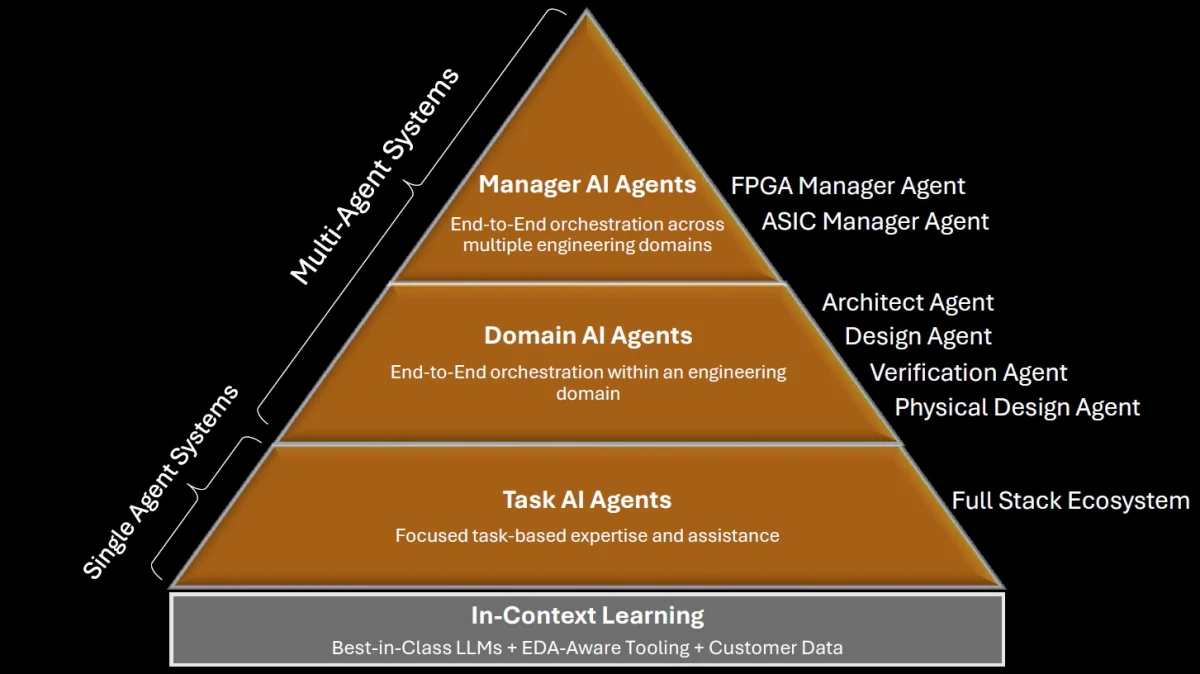
ChipNexus describes NEX as a hierarchy of task, domain and manager agents coordinated by its NEXUS technology. (Source: ChipNexus)
The structure resembles an engineering team: specialists carry out defined tasks, domain leads coordinate related work, and managers oversee activity across the project. NEXUS supplies the orchestration layer, which ChipNexus calls its “agentic harness.” It connects AI models, agents, engineering knowledge and EDA tools, while controlling the information passed between them.
Context management is central to the idea. Gaillardon compared an AI agent to a new engineering graduate handed an entire design database, all the documentation and every simulation waveform, then told to find a bug. Giving that engineer the failing signal, relevant module, connections and specification would make the task more tractable. ChipNexus says its harness works in a similar way by providing agents with focused information for each job.
The company says this can improve accuracy while reducing token use, execution time and cost. Those are company claims; the details provided do not include benchmark figures or test conditions for quantifying the changes. NEX is also designed to work with different AI models and connect to EDA software through scripting interfaces and other supported mechanisms, rather than relying on one model or one EDA supplier.
Applying the workflow to analog circuits
In an analog design flow, an engineer starts with a circuit and requirements, then configures simulations, studies waveforms, measures performance and adjusts component values. They may compare alternatives before moving into layout, where parasitic effects and design-rule checks add further constraints. The design also has to be evaluated across process, voltage and temperature variations.
That sequence creates opportunities to automate bounded, repetitive tasks without automating the full engineering judgment behind them. ChipNexus says an engineer can use natural-language instructions to request simulation setup, measurements, plots or an initial layout. Specialized agents then interact with the existing EDA tools, and the framework coordinates the work and returns results that can inform later steps.
Working inside established environments is a practical part of the pitch. ChipNexus says its software runs within the customer’s own environment and operates alongside existing tools and workflows. That can matter to design teams handling proprietary circuits and intellectual property, and it avoids making adoption depend on replacing the tools around which their processes are already built.
The company isn’t claiming that its agents can outperform experienced analog designers. Gaillardon described the goal as helping engineers become “super engineers” by taking tedious tasks off their workload, so they can spend more time on work that requires expertise. That framing fits the limits of analog automation: a tool can prepare and analyze a simulation, but engineers still need to judge whether its assumptions and results make sense for the circuit and its intended use.
Where the practical value will show up
For teams with experienced analog designers, the immediate question is whether agent-assisted workflows save enough time to justify integrating them into a working design process. Simulation setup, plotting and measurement are specific tasks that can be assessed against existing practice. Layout generation and follow-on analysis bring additional complexity, so useful evaluation will depend on how well the agents handle the team’s actual circuits, constraints and tool configurations.
The staffing context makes that productivity question relevant. The growth of digital electronics did not eliminate analog work; it increased the need for analog and mixed-signal circuits at interfaces and in high-performance systems. If experienced designers are in short supply, tools that let them spend less time on repetitive operations could help teams make better use of their expertise. The source information does not establish how much time NEX saves or how broadly it has been evaluated, so those outcomes remain to be demonstrated through use.
ChipNexus is also working on digital design, verification, physical implementation and its underlying multi-agent orchestration technology. For analog engineers, the notable development is the extension of that framework into flows built around Virtuoso, Spectre and Calibre. The test will be whether it can consistently prepare useful work, pass the right context between steps and leave clear results for engineers to review. If it does, the agents could become a practical addition to analog design teams without changing the central role of the people who understand the circuit.