OLED Displays: Pixel Architecture, Emission Types and Practical Trade-offs
- Published
- Author
- Komal Ganvir
- Reads
- 857
OLED pixels emit their own light, enabling deep blacks and thin, flexible displays, with trade-offs in cost, ageing and moisture protection.
OLED displays generate light at the pixel, so they can produce deep blacks without a separate backlight. That architecture also supports thin panels, wide viewing angles and flexible form factors. The engineering trade-offs sit in the organic materials and their protection: manufacturing cost, moisture sensitivity and uneven ageing all affect how a panel performs over time.
OLED, or organic light-emitting diode, uses electroluminescence: an applied electrical current causes organic materials to emit light. The organic layers are typically only a few hundred nanometers thick. That thin stack can be built on glass, transparent plastic or flexible metal foil, allowing designs that range from rigid televisions to foldable devices and transparent displays.
What happens inside an OLED pixel
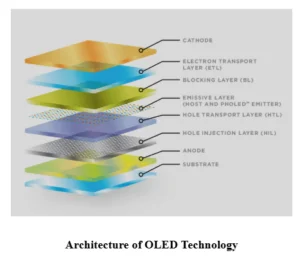
A typical OLED stack places organic layers between two electrodes, supported by a substrate. When direct current is applied, the anode supplies holes and the cathode injects electrons. The charges move through the organic layers toward the emissive layer, where they recombine and release energy as photons. The emissive material determines the light’s colour.
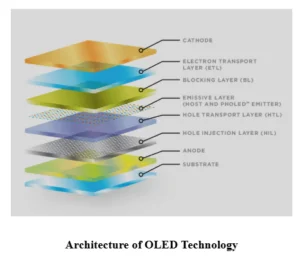
The substrate provides mechanical support and helps determine whether the panel is rigid or flexible. The anode is the positive electrode; transparent indium tin oxide (ITO) is commonly used so emitted light can pass through it. A conductive organic layer carries holes toward the emissive region. Polyaniline and poly(3,4-ethylenedioxythiophene), or PEDOT, are among the materials used for this layer.
In the emissive layer, organic molecules or polymers produce light as electrons and holes recombine. Different emissive materials generate red, green or blue output, which can be combined to produce a range of colours. The cathode supplies electrons and may use aluminium, magnesium, calcium or alloys of these materials. Depending on the design, it can be transparent or opaque.
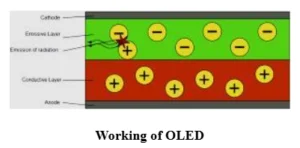
Controlling the current to individual pixels sets their brightness and, across the panel, builds the displayed image. A pixel can also be switched off entirely. That’s the source of OLED’s strong black levels and contrast: a dark pixel need not emit light at all.
Display structures and emission approaches
OLED describes a family of designs, not one fixed panel structure. The choice of pixel control, substrate and light-emission direction shapes where a display fits and what constraints it faces.
PMOLED and AMOLED
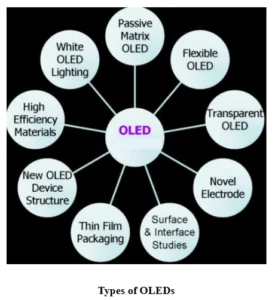
Passive-matrix OLED (PMOLED) panels arrange anodes and cathodes as rows and columns. External circuitry selects the pixels by driving the corresponding lines. The relatively simple structure suits small screens, including basic mobile phones and smartwatches, but power efficiency and resolution make PMOLED less suitable for larger panels.
Active-matrix OLED (AMOLED) uses a thin-film transistor (TFT) array to control pixels individually. Switching circuits regulate current to each OLED element, supporting high resolution, fast response and larger displays. AMOLED is used in smartphones, tablets, televisions and smartwatches.
Panel direction, transparency and flexibility
In a top-emitting OLED, light exits through the upper electrode instead of the substrate. A reflective substrate can direct more light toward the viewer, an arrangement that can suit active-matrix panels and improve light output and efficiency.
Transparent OLED designs use transparent electrodes and substrates. They can show an image while allowing light through the panel when it isn’t emitting. Potential uses include heads-up displays, transparent televisions, smart windows and digital signage.
Flexible OLEDs place the organic stack on a flexible substrate, such as plastic or thin metal foil, in place of rigid glass. The resulting panel can bend, curve or fold within the limits of its design. This construction enables foldable smartphones, curved displays, wearable devices and other products with non-flat screens.
White and phosphorescent OLEDs
White OLED (WOLED) panels produce white light from organic emitters. In displays, colour filters can turn that output into different colours; WOLED is also used in televisions and lighting panels. For lighting, a broad emitting surface can provide uniform illumination.
Phosphorescent OLED (PHOLED) materials can, in theory, convert nearly all electrically generated excitons into light. That offers a route to higher efficiency than conventional fluorescent OLED materials. The approach is relevant to displays and lighting where efficiency, power use and brightness matter.
Benefits and limits in use
Because each pixel makes its own light, OLED panels don’t need a separate backlight. That helps manufacturers build thin, lightweight displays and enables flexible or curved products. Pixels that switch off can reduce power use when the image contains dark areas. OLEDs also offer wide viewing angles, vivid colour reproduction and fast pixel response, making them useful for video and gaming.
The same pixel-by-pixel operation has a practical limitation: a static image held for long periods can age pixels unevenly and leave permanent image retention, commonly called burn-in. Organic materials also degrade over time; blue emitters are particularly susceptible, affecting brightness and colour performance. Some OLED panels have limits on sustained full-screen brightness compared with certain LCD designs.
Moisture and oxygen can damage the organic layers, so OLED panels need effective encapsulation. Production also involves complex processes and material requirements, contributing to higher manufacturing costs. These constraints help explain why OLED’s thinness and image quality come with design and durability considerations.
- Contrast: Individual pixels can turn off for deep blacks.
- Power: Dark images can use less power because fewer pixels emit light.
- Speed and viewing: Fast response and wide viewing angles suit video and interactive displays.
- Form factor: A backlight-free stack supports thin, lightweight and flexible panels.
- Durability: Organic material ageing, image retention and protection from moisture remain design concerns.
Where OLED panels are used
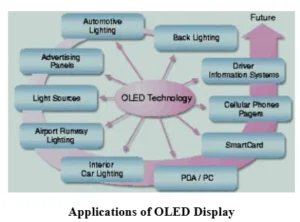
Televisions and monitors use OLED’s contrast, colour and viewing-angle characteristics. OLED monitors also serve gaming, video editing and graphic design, where response and colour reproduction matter. Smartphones commonly use AMOLED panels for their thin profile and high-resolution images; compact, low-power displays also suit smartwatches and other wearable devices.
Digital cameras use OLED screens and electronic viewfinders to show images with strong contrast and colour. OLED lighting panels take a different approach from pixel-based displays: they emit uniform light across a surface and can be made thin, flexible or transparent for architectural, decorative and commercial settings. Programmable keyboards can use small OLED panels or display-equipped keys to show icons, shortcuts or application controls.
Foldable phones, curved panels and rollable screens put the flexible substrate to work in products where the display surface changes shape. For designers, the central decision is whether the benefits of self-emitting pixels and adaptable form factors justify the added demands of cost, encapsulation and long-term pixel ageing.