Maglev Trains: How EMS and EDS Systems Lift, Guide and Propel Them
- Published
- Author
- Komal Ganvir
- Reads
- 472
Maglev trains use magnetic forces and linear motors for high-speed travel, but dedicated guideways, energy demand and system costs shape where they fit.
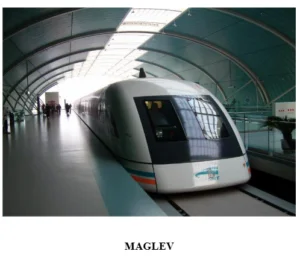
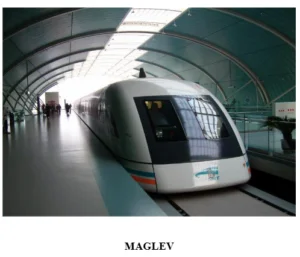
Maglev trains replace wheel-on-rail motion with magnetic levitation and electromagnetic propulsion. That removes rolling contact during high-speed operation, reducing mechanical wear and rolling noise while allowing very high speeds. The trade-off is a dedicated guideway packed with controlled electromagnetic systems, plus increasing aerodynamic drag as speed rises.
One system handles lift, guidance and propulsion
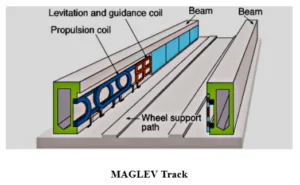
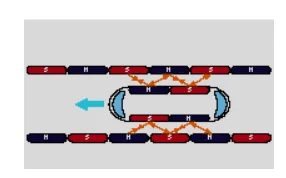
Magnetic forces suspend the train above its guideway and help keep it aligned as it travels. Propulsion comes from a linear motor: coils in or along the guideway create changing magnetic fields that interact with magnets on the train. By controlling the timing and direction of those fields, the system produces a sequence of forces that moves the train forward.
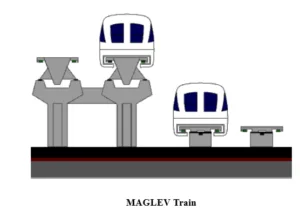
The same basic architecture ties together several functions. Magnetic attraction or repulsion provides lift; the magnetic arrangement helps guide the vehicle; and controlled current in the guideway coils generates propulsion. The frequency and timing of that current also regulate speed: changing them changes the rate at which the magnetic field pattern travels along the guideway.
EMS and EDS create lift in different ways
Electromagnetic suspension (EMS) uses attraction. Electromagnets beneath the train pull toward a steel guideway, creating a small levitation gap. Electronic controls continuously adjust the magnetic force to keep that gap stable. Because the lift comes from attraction, EMS can levitate while stationary. Some high-speed systems developed in Germany and other countries use this approach.
Electrodynamic suspension (EDS) relies on repulsion. Superconducting magnets or other magnetic arrangements on the vehicle interact with guideway coils. As the train moves, changing magnetic fields induce currents in those coils; the resulting magnetic forces lift and stabilize the train. EDS generally needs the vehicle to reach a certain speed before it develops enough lift, so some designs use wheels at low speed. Japanese high-speed maglev systems use EDS with superconducting magnets.
These approaches put different demands on the vehicle and its controls. EMS needs active adjustment to hold a small gap, while EDS depends on motion to generate sufficient levitation force. In both cases, magnetic guidance and propulsion must work with the guideway as a coordinated system.
The guideway is part of the machine
A maglev guideway does more than support a vehicle. It contains coils and other components for levitation, guidance and propulsion, with controlled electrical current producing the magnetic fields that interact with the train. Its design must maintain the conditions needed for stable operation along the route.
That makes maglev incompatible with ordinary railway tracks. Conventional trains use steel wheels on steel rails and rely on onboard engines or electric motors for motion. Maglev vehicles use electromagnetic forces and a linear motor system, with the propulsion equipment installed along the guideway or incorporated into the train system depending on the design. Their specialized infrastructure is a central part of the technology’s cost and deployment challenge.
Commercial service shows both the potential and the limits
Maglev systems have been developed and tested in Germany, Japan, China and South Korea. Birmingham, England, introduced the first commercial maglev transportation service in 1984, connecting Birmingham International Airport with a nearby railway station. The system closed in 1995 after operational and reliability problems.
The Shanghai Maglev connects Shanghai Pudong International Airport with Longyang Road station. It has reached speeds of up to approximately 431 km/h during commercial service. That performance illustrates the speed potential of avoiding wheel-to-rail friction. But at high speeds, aerodynamic drag becomes the main resistance, so eliminating rolling contact doesn’t eliminate the energy needed to keep the train moving.
Where the engineering trade-offs sit
With no direct wheel-and-rail contact during levitation, maglev systems can reduce mechanical wear and vibration. Less rolling noise can make for a quieter ride, although aerodynamic noise grows at higher speeds. Linear motor propulsion can support rapid acceleration and deceleration, and fewer mechanical contact parts may reduce some maintenance needs.
The advantages come with significant infrastructure and control requirements. A route needs a dedicated guideway and specialized electromagnetic equipment; construction and maintenance can be costly. Levitation, guidance and propulsion also depend on advanced control and monitoring systems. Compared with conventional rail, maglev networks remain limited, which constrains where passengers can use them.
Energy use depends on operating conditions. At very high speed, aerodynamic drag rises and demands substantial propulsion energy. The environmental impact also depends on how electricity is generated, the resources used to build the infrastructure, energy consumption and passenger capacity. Electric operation can reduce local emissions, especially when powered by renewable electricity, while lower rolling noise and mechanical losses offer other potential benefits.
Applications depend on route and infrastructure
Proposed and existing uses include high-speed passenger and intercity travel, airport connections, urban transportation, advanced railway projects and experimental high-speed systems. The practical question for any application is whether the speed and operating characteristics justify the cost of building and maintaining a separate guideway.
Maglev’s defining engineering choice is to integrate the vehicle with its track through controlled magnetic fields. That can deliver smooth, fast travel with less mechanical contact, but it also makes the guideway, controls and electrical supply inseparable from the transport system. Route economics, energy demand and reliability will determine where that trade-off makes sense.