DigiKey AIoT Design Challenge 2026 Names 18 Winners from 3,870 Entries
- Published
- Author
- Semiconductor For You
- Reads
- 903
The challenge recognized 18 projects spanning water network monitoring, inventory forecasting and predictive maintenance for industrial motors.
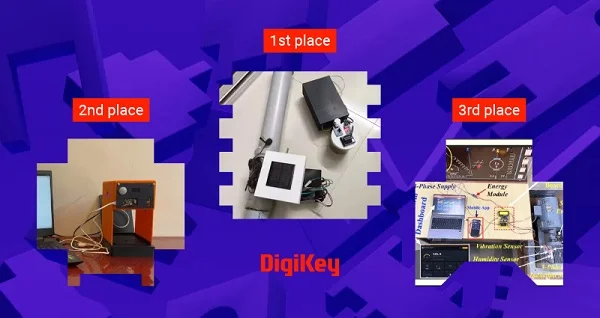
Eighteen projects were selected from 3,870 registrations in the AIoT Design Challenge 2026, with winning entries applying artificial intelligence and connected sensors to practical engineering problems. The top three address water network monitoring, manufacturing inventory and industrial motor maintenance, showing how varied the work can be when sensing, communication and data analysis are combined.
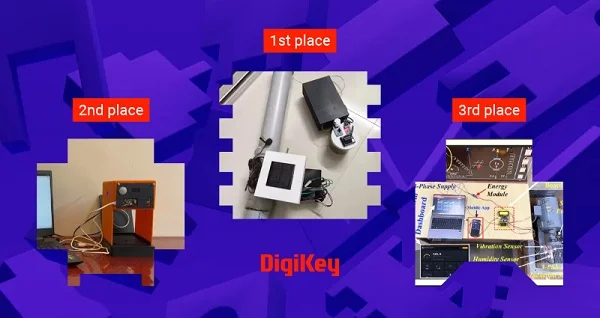
DigiKey announced the winners in Bengaluru, India. A panel of industry judges and the Electronics For You (EFY) community selected the 18 projects. Entries were assessed for creativity and innovation, use of components sourced through DigiKey, documentation, real-world applicability and the quality of video demonstrations.
Three distinct engineering problems
First place went to Jal Rakshak, developed by Varun Sontakke. The project is described as an autonomous, decentralized AIoT water security system for municipal networks. It combines edge AI, smart sensors and long-range communications to detect leaks, contamination and infrastructure failures.
Those functions put measurement and local data processing at the center of the design. Sensors provide information about network conditions, while edge AI supports analysis closer to where data is collected. Long-range communication links the distributed system. The stated aim is to identify several kinds of problem in water infrastructure; no sensor types, detection thresholds, communication protocol or field trial results were specified.
PRISM, created by Mydhily M R, took second place. The inventory platform combines real-time stock monitoring with machine-learning forecasting, with the goal of helping manufacturers anticipate shortages. Its pairing of current inventory data and forecasts targets a common planning challenge: knowing both what is available now and whether supply is likely to meet future needs. The project description doesn't identify the forecasting inputs, model, or the time horizon used.
Third place was awarded to Rajanikant Metri’s “AIoT-Based Predictive Maintenance & Digital Twin Adaptive Control for Industrial Motors.” The project brings together real-time condition monitoring, anomaly detection and data-driven maintenance planning to improve operational reliability. Its title also identifies digital twin adaptive control as part of the design. The available description doesn't detail the motor types, measured signals, control method or test conditions, so the scope of the implementation can't be assessed from those specifications.
What the judging criteria reward
The criteria covered more than the use of AI or connected hardware alone. Judges considered how creatively a project was designed, whether its components were sourced through DigiKey, how clearly its work was documented, and whether it had a plausible application beyond a demonstration. Video demonstrations were also part of the evaluation, making it possible to show project behavior alongside written material.
That combination favors entries that connect technical choices to a defined use. A sensor and a model matter because they serve a monitoring or prediction task; documentation and demonstrations help explain how the system is assembled and what it can do. At the same time, the stated criteria don't provide performance figures or a common test protocol for comparing projects. Recognition therefore signals that entries met the challenge's evaluation goals, but it doesn't establish equivalent operating performance across very different applications.
Recognition for 18 projects
The competition awarded ₹1,00,000 for first place, ₹30,000 for second place and ₹20,000 for third place. Fifteen additional projects received “Most Popular” recognition, with selections identified through public input. Their names and technical details aren't included in the available project descriptions.
Winners received cash prizes, development boards, industry recognition and promotional opportunities through EFY’s editorial and digital platforms. DigiKey said the challenge was intended to encourage engineers to develop practical solutions with AI and IoT, and that participants had access to educational resources, development platforms and technical guidance.
The leading projects illustrate three different uses for connected engineering: detecting problems across distributed infrastructure, forecasting material needs in manufacturing, and planning maintenance around motor condition. The challenge's next useful measure will be how these designs perform when their sensing, communications and analytical methods are evaluated under clearly described operating conditions.
The challenge results page lists the winners and project details.