Why Physical Computing Still Anchors Computer Science in the AI Classroom
- Published
- Author
- Meg Wang
- Reads
- 872
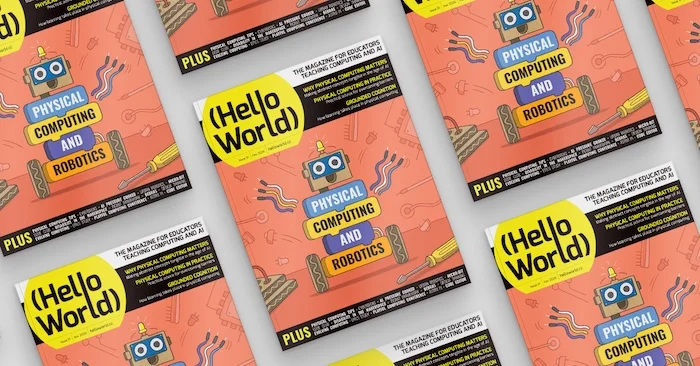
Educators in Hello World issue 31 argue that physical computing still anchors computer science, and that it pairs well with AI in the classroom.
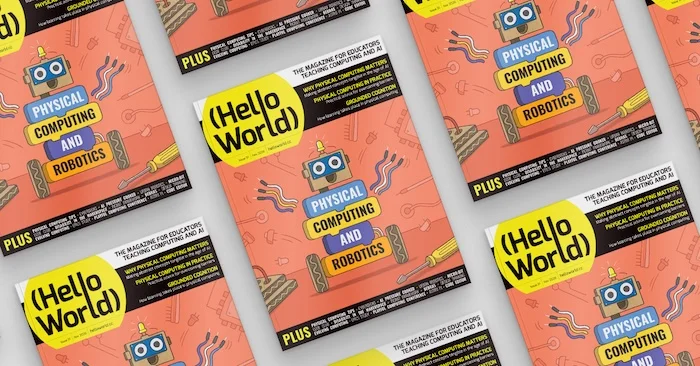
With AI reshaping what schools teach and how students learn to code, it's fair to ask whether wiring up LEDs, sensors and motors still earns its place in a computer science lesson. The educators featured in the latest issue of Hello World think it does, and they're not hedging about it.
The contributors come from many countries and teaching situations, from urban classrooms to rural schools. Their approaches range from fully unplugged activities with paper and no hardware at all, to projects that bring AI into the build. What links them is the way physical computing turns abstract ideas into something a learner can see and touch. A variable stops being a line of text and becomes a brightness level. A loop becomes a blinking light.
The confidence problem comes first
Plenty of teachers say the hardest part isn't the hardware. It's their own confidence. Many educators haven't built a circuit since school, and the idea of debugging a board in front of a class is daunting. The issue tackles that head-on, with practical advice on getting started and an article from James Robinson on the common barriers that stop teachers from bringing physical computing into their practice.
Robinson's point about early wins is the one I'd underline. In his words:
"Whenever I have run physical computing workshops with teachers or students, there is usually a literal light bulb moment: when learners discover that they can control a simple light bulb LED with a piece of code they have written, and it works, they are thrilled. Finding ways for you and your students to have quick wins breeds success and confidence." — James Robinson, Hello World issue 31
That's a sound instinct. A single LED driven by a few lines of code proves the whole chain works: the program runs, the output pin changes state, and current flows through the component. Once a learner sees that loop close, debugging a sensor or a motor feels like a manageable next step rather than a leap into the unknown. Teachers planning a first session should probably aim for that kind of short, certain success before adding complexity.
Where physical computing meets machine learning and data
The issue goes well beyond introductory circuits. Its articles cover how physical computing can teach:
- Machine learning through movement, where students train a model on sensor data from their own bodies or devices
- Environmental data science, collecting readings from the real world and dealing with the messiness that real measurements bring
- Secondary-level programming and cybersecurity, where hardware makes questions about access, networks and data handling concrete
The machine learning angle is worth a closer look. Sensor data is noisy, calibration drifts, and a model trained in one room may behave differently in another. Those are lessons that a spreadsheet rarely teaches. When the input comes from an accelerometer or a light sensor that a student is physically waving around, the gap between a clean dataset and a real one becomes obvious very quickly.
AI and physical computing aren't competing
Some of the writers in the issue describe how they combine AI with physical computing. The argument is straightforward. Self-driving cars and humanoid robots depend on AI to interpret the world, but they still need physical computing to sense it and act on it. A perception model means little without sensors feeding it, and a decision means little without actuators to carry it out. Together, those layers connect the digital and physical worlds.
For educators, that's a useful framing. Rather than treating AI as a replacement for hands-on work, you can use the hardware as the place where AI's outputs have consequences. A classifier that decides whether a sound is a clap or a knock becomes far more interesting when it switches a light.
The issue also includes an exploration of the PICRAT framework, which grades how technology is used in learning, from passive consumption at one end to transformative use at the other. Used alongside a physical computing project, a framework like that helps a teacher check whether students are simply following a build guide or actually creating something new. That's a question worth asking of any hardware lesson, whatever the tools.
Beyond the core topics
Feature articles address how to survive what the issue calls the AI pressure cooker, and there's a conversation about the future of studying computer science. The wider contents also cover cyberdecks, disability and inclusion in the makerspace, and playful computing. That mix suggests the editors see physical computing as a broad practice, not just a hardware skill set.
If you're already mentoring a robotics team, you'll find plenty to compare against your own sessions. If you're starting from paper circuits, the unplugged and low-cost approaches are likely the more useful entry point. Either way, the free digital copy is available from the Hello World issue 31 page.
My read: the debate about AI in education is pushing some schools to move screens and chatbots to the centre. This issue makes a strong case for keeping the physical side in the mix. The next useful test is whether your first project this term gets a light to blink, because that moment is what keeps learners coming back for the harder work.