MassRobotics Startups Get a Look Inside ADI's Robotics Engineering Hub
- Published
- Author
- Hannah Shapiro
- Reads
- 720
MassRobotics founders spent a day with Analog Devices' Emerging Tech Hub, learning how a large chip supplier's teams can support robotics startups from prototype to production.
Hardware startups rarely fail for lack of a good idea. They stall in the gap between a working prototype and a product that customers will buy at volume, and robotics companies feel that gap more sharply than most. So a day spent with a major semiconductor supplier's engineers is worth paying attention to, especially when the supplier is trying to show founders exactly which doors are open.
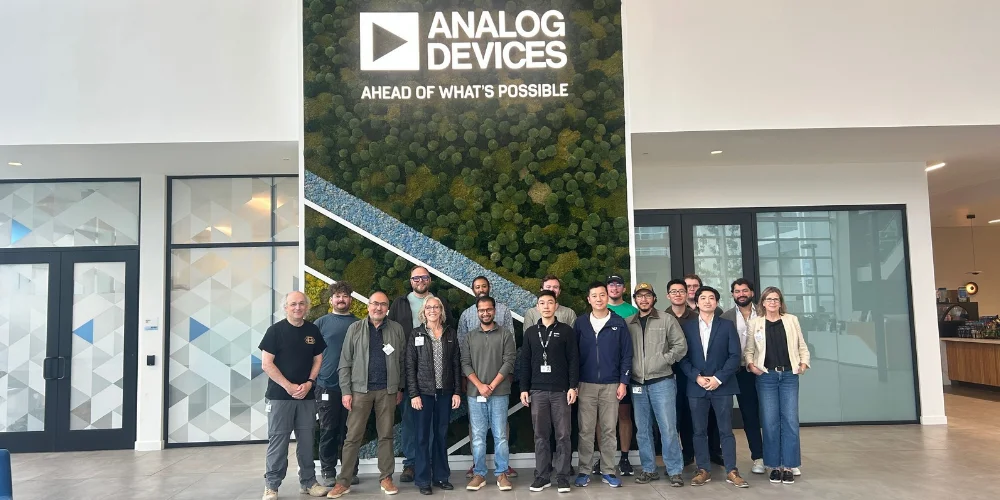
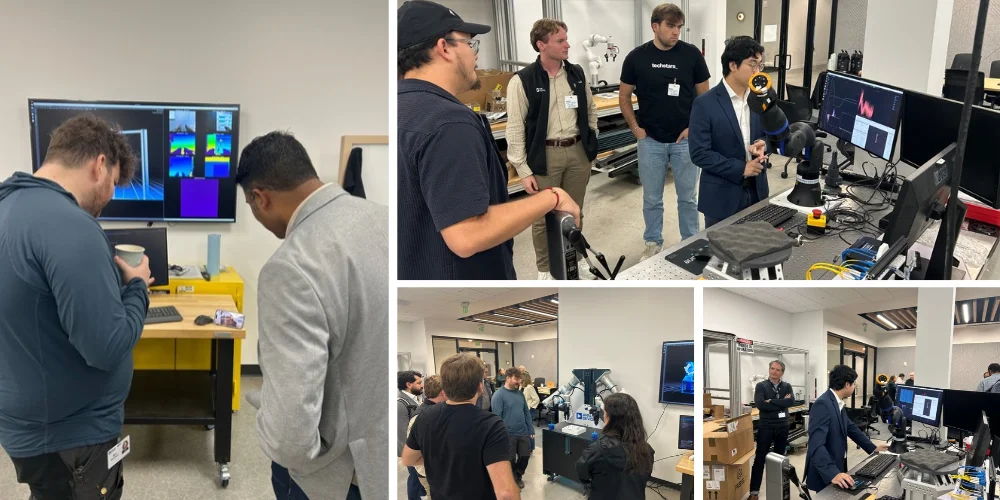
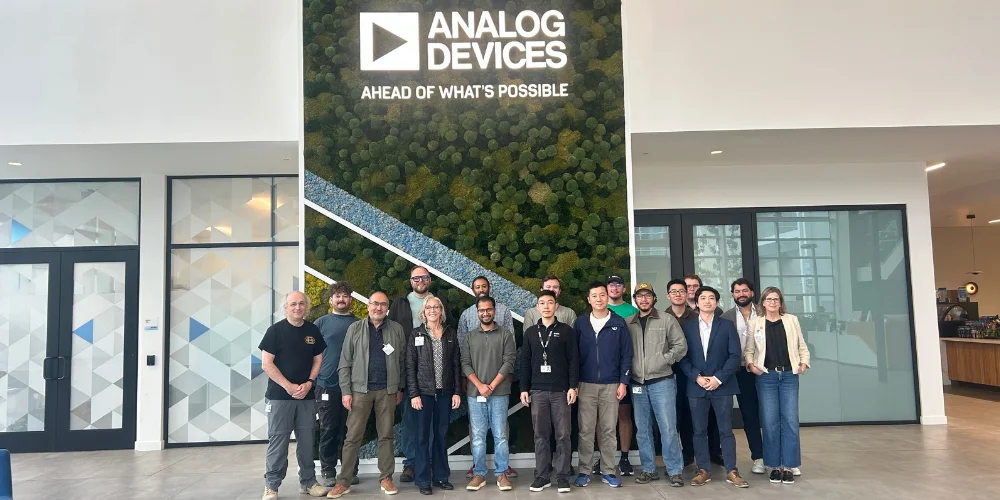
On October 22, MassRobotics took a group of early-stage robotics startups to Analog Devices' co-creation space in San Jose for a Startup Open House hosted by ADI's Emerging Tech Hub. The aim was to put founders in the same room as people who can help them build and scale. The startups came from tactile sensing, smart materials, autonomy, and Physica AI, and included Contactile, RasLabs, P!ng, Saro Robotics, Vizi AI, Gitinama, and Hardhat Robotics.
For a hardware founder, a large corporation can look like a maze. Big companies bring longer timelines, layered org charts, and a long list of people to persuade. They also bring components, customers, and capital that a young company struggles to find elsewhere. The open house was built to show that the upside is reachable, and to show how to get to it.
Four ways in, and why that matters
ADI is a MassRobotics strategic sponsor, and its involvement goes beyond branding. Colm Prendergast, who heads the Emerging Tech Hub at Analog Garage, committed to offering MassRobotics startup residents engineering services and domain expertise to help them move their technical plans along faster. The visit was the first real demonstration of that offer.
The day ran in rotations. After introductions to several ADI teams and an overview of what each group offers, founders split into small groups and cycled through 30-minute sessions with three of them. ADVentures, the corporate venture arm, worked alongside Analog Garage. ADI's sales and robotics business unit teams covered the commercial side. The Emerging Tech Hub ran a tour of its robotics lab with live demos. A wrap-up discussion closed the session, with founders sharing takeaways and giving ADI feedback.
The framing that seemed to land hardest came early. ADI argued that go-to-market for robotics is structurally different from software. A software company faces one chasm, moving from early adopters to the mainstream. A robotics company faces two. The first sits between prototype and early adopters. The second, between early adopters and the early majority, is where hardware scaling gets especially hard. Here's the thing: most founders know the first gap intimately. The second one tends to surprise them.
ADI says it sees a role on both sides of that divide. It positions its engineering help around MVP and proof-of-concept work for the first chasm, and product development for the second. To structure that help, the company describes four ways to engage, each backed by a different team:
- Vendor: ADI's robotics business unit and sales teams supply components and design support.
- Partner: the Emerging Tech Hub works hands-on with startups on technical challenges.
- Joint development: Analog Garage, ADI's breakthrough technology incubator, explores co-development opportunities.
- Investor: ADVentures, ADI's corporate venture fund, invests in early-stage startups at the intersection of the physical and digital worlds.
My read is that the four-door model is the most useful idea in the whole day. A founder who walks into a company this size and asks for "help" will get routed somewhere, possibly to the wrong place. A founder who asks for a reference design review, a sourcing conversation, or an equity-stage discussion knows exactly which team to call. Knowing which door fits your stage and need is half the battle.

What the Emerging Tech Hub actually does
The Emerging Tech Hub sits within Analog Garage and is designed to close the technical and commercialization gaps that slow startups down, so founders can spend their time on the product itself. The Robot Report has described the Hub as a robotics-focused initiative that connects startups and established robotics companies with ADI's technical teams, including engineers working with newly released or still-in-development technologies.
ADI frames the path in four stages, with the Hub involved at each one:
- Idea: turn the vision into a clear path forward.
- Prototype: build and test rapidly, with expert guidance.
- Validate: verify performance, refine the solution, and reduce risk.
- Scale: prepare for production and grow with confidence.
ADI groups what startups receive into three areas. Technical expertise means access to engineers and domain specialists across robotics, controls, edge AI, power, and system integration. Development resources cover labs, tools, rapid prototyping, test and validation, and reference designs. Scale readiness covers designing with ADI parts, sourcing, production readiness, and industry connections.
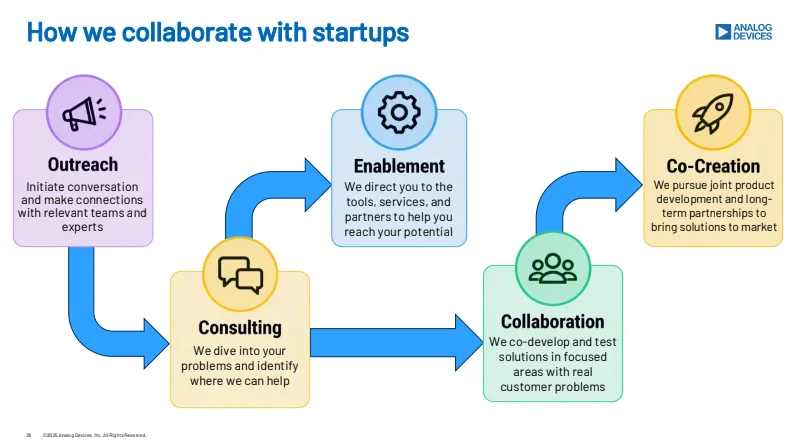
Engagements can be as small or as deep as the company needs. Some startups want a short advisory call. Others need months of technical support, or full co-development. The Hub's process begins with outreach and consulting to pin down a company's challenges. From there it moves to enablement, which means pointing founders to the right tools, services, and partners. Next comes collaboration on real customer problems, and finally co-creation through joint product work and longer-term relationships. Cameron Villone of the Hub describes the method as co-development: start by establishing where a company stands today and what it's trying to reach, then align those goals with the Hub's mission.
Two points stood out for founders. Startups keep their intellectual property. And the model is meant to be collaborative rather than competitive, which matters when a supplier's engineers are looking at the same kind of machine a startup is building. Engagement terms are meant to fit how young companies actually operate, not the other way around.
The lab tour and a cable-swapping robot
The lab tour showed what co-development looks like on the bench. One highlight was a proof of concept the Hub first built for NVIDIA GTC in March 2026: a bimanual robot that manipulates cables in a data center. The task involved swapping cables on a server rack. It needed precise two-handed coordination in tight, low-visibility spaces, with millimeter-level positioning to align connectors without damaging ports.
That kind of task is a useful lens for hardware teams. Sub-millimeter alignment in a cramped space with poor sight lines leaves little room for error, and the sensing choices made early in the design largely determine whether the robot can do the job at all. Founders in the room saw how those decisions cascade through the rest of the system, from grippers and controls to how the machine confirms that a connector is seated.
What comes next
For the startups, the most concrete result was the contacts. Founders left with direct lines into ADI's venture, sales, and engineering teams, along with a clearer sense of how those engineers could help them prototype faster, de-risk designs, and prepare for production. An introduction only matters if it turns into a conversation, and this day was built to make that happen.
That's the point of MassRobotics as well: connecting its startups with the partners, resources, and expertise they need to scale. The organization thanked Colm Prendergast, the Emerging Tech Hub, ADVentures, Analog Garage, and ADI's sales and business unit teams for the day, and for continued support as a strategic sponsor.
The thing to watch is what follows the handshakes. Which of these eight companies moves into a validation or co-development engagement, and which sensing or control problems come out of those projects, will show whether a day like this turns into design wins. For engineers building robots outside the big-company world, the lesson is already clear: learn which team to approach for which problem, and go in with a specific technical question.