ISO 21423 Extends AMR Interoperability Across Robots, Fleet Systems and Factory Equipment
- Published
- Author
- Hannah Shapiro
- Reads
- 754
ISO 21423 builds on open AMR interfaces to help robots, fleet managers and facility systems exchange status and coordinate work across shared spaces.
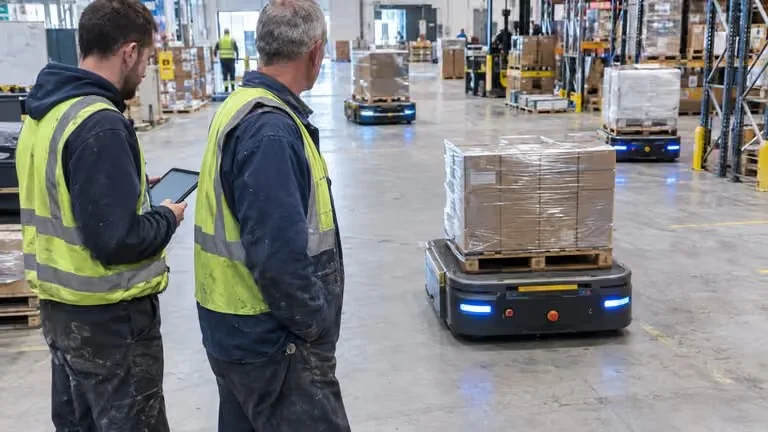
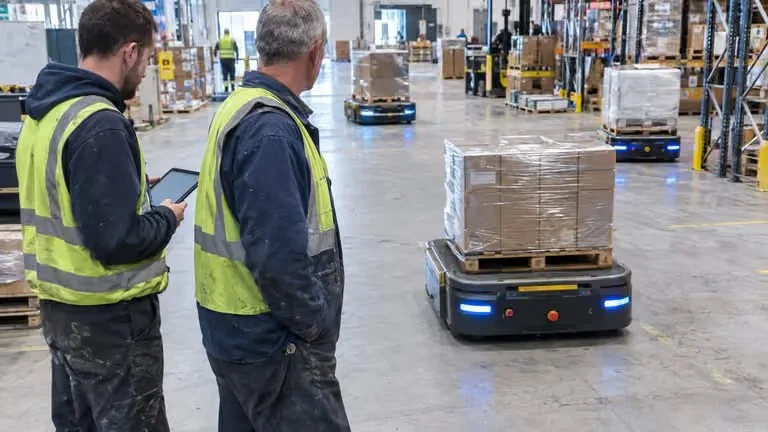
ISO 21423 gives industrial mobile robots and the systems around them a shared way to exchange information and request actions. Its significance is practical: a facility can coordinate robots from different suppliers and connect them with equipment such as automated doors and lifts, reducing the custom integration needed to make a mixed fleet work in one space.
The standard builds on two earlier approaches: the MassRobotics Interoperability Standard, piloted in North America, and VDA 5050, widely adopted in Europe. Developed through ISO Technical Committee 299, Working Group 10, the work drew nearly 90 participants from more than a dozen countries. Members of Germany’s VDMA helped align the approaches.
From shared floor problem to open interface
The work began in 2020, when MassRobotics formed its AMR Interoperability Working Group. Robot developers and end users had a common operational problem: organizations were testing mobile robots from several vendors, yet no single supplier could cover every task. Without a shared interface, making those machines coexist could require separate integrations between each vendor’s equipment and site systems.
Contributors included Vecna Robotics, 6 River Systems, Waypoint Robotics, Locus Robotics, Seegrid, MiR, Autoguide Mobile Robots, Third Wave Automation, A3 and Open Robotics. End users such as FedEx, Procter & Gamble and DHL helped establish the need for multi-vendor operation on real facilities.
The group kept its first specification deliberately simple to make adoption easier. It focused on robot-to-robot information exchange: location, speed, direction, health and availability. Published in 2021, the open-source specification was made freely available through GitHub. The first trial took place at a FedEx facility, where AMRs from Waypoint Robotics, Vecna Robotics and other suppliers operated in the same space. The trial put the core idea into practice: robots need enough shared status information to account for one another as they move and work.
The initial interface addressed an important but bounded problem. A robot’s position and direction can help other machines anticipate its movement, while health and availability give fleet systems information about whether it can take on work. A common data exchange can therefore support coordination across a mixed fleet without requiring every robot to use the same vendor’s software. It does not, by itself, determine how a facility should assign work or design its traffic rules; those remain part of the wider operating system and site setup.
What ISO 21423 adds
ISO 21423 extends the information exchanged beyond the original robot-to-robot focus. Robots can share location, speed, direction, condition, tasking and availability, while the wider scope covers communication with fleet managers and other equipment. That includes lifts, automated doors, alarms, enterprise resource planning (ERP) systems and workers carrying mobile devices.
This broader scope matters because mobile robots interact with more than one another. A robot may need to coordinate with a lift or door to move between areas, while fleet software needs information about the robot’s condition and assigned task. Connecting these exchanges through a common framework can reduce the number of one-off interfaces a facility must maintain as it adds equipment or changes its fleet.
The specification uses MQTT and JSON, technologies already used by companies implementing the MassRobotics standard. Those implementations start close to ISO 21423 compliance, although the exact work needed will depend on how a particular system handles the expanded requirements. The standard also offers facilities a common basis for deployments across regions, bringing together approaches that had developed on different sides of the Atlantic.
For operators, the expected gains are fewer robots obstructing one another, less human intervention to clear jams, and higher robot availability. A shared interface can also make it easier to select a robot for a particular job without repeating custom integration for each supplier. Those outcomes depend on implementation and site conditions; the interface supplies a way to exchange information and request actions, while the facility still has to configure its equipment and workflows to use that information effectively.
Adoption will determine the operational effect
ISO 21423 marks a step from an open specification and facility trials toward an international framework. A3 described it as the first non-safety robot standard it has helped produce. For engineering teams, the relevant question now is how quickly robot makers, fleet software providers and equipment suppliers implement the shared requirements in the systems they deliver.
The standard’s value will grow as more of the equipment on a shared floor can communicate through compatible interfaces. Facilities considering multi-vendor fleets can look at their current robot and system integrations to see where common data exchange could reduce bespoke connections. The next measure of progress is adoption across those systems, and whether it makes mixed fleets easier to operate as facilities expand or change their automation.


