Robotics Targets Logan’s Space, Baggage and Airfield Maintenance Constraints
- Published
- Author
- Hannah Shapiro
- Reads
- 742
Nine startups presented airport robotics for mobility, cleaning, baggage handling and airfield work as Massport looks to grow capacity through better operations.
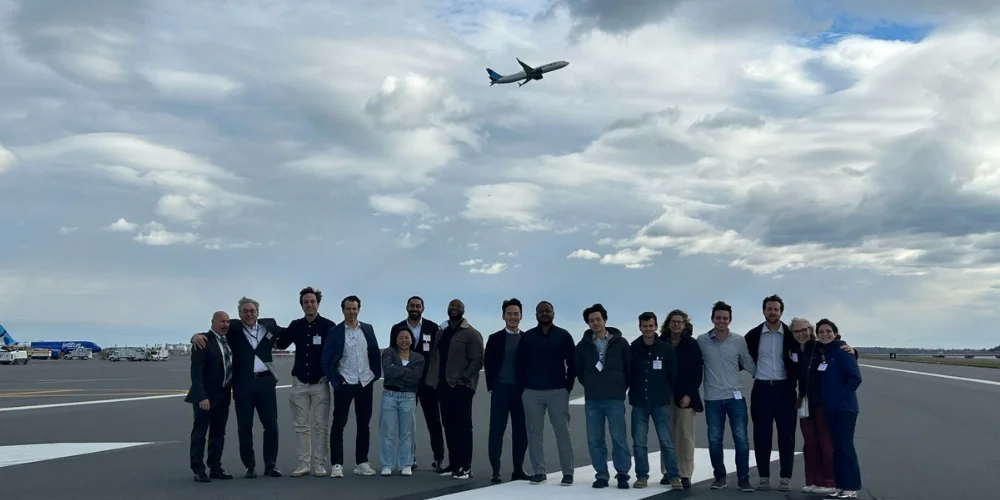
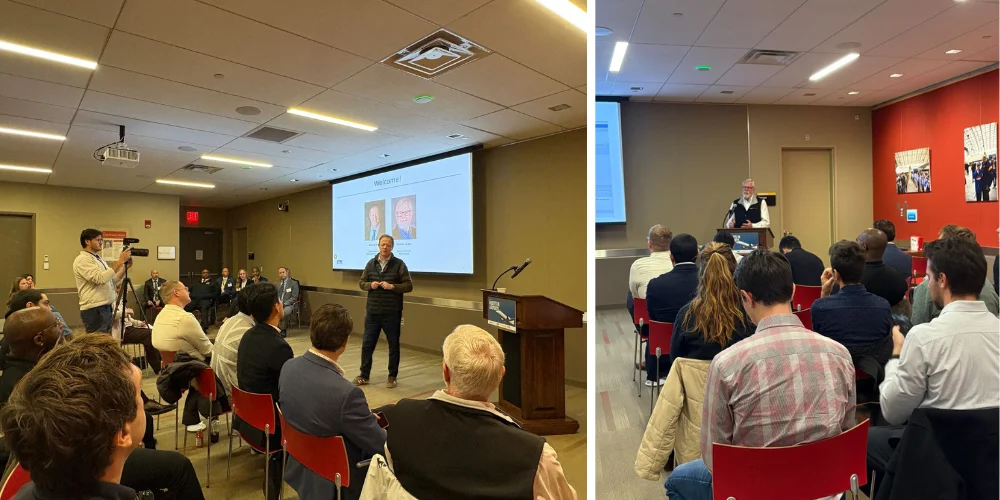
At Boston Logan, adding capacity means making better use of limited space. That constraint shaped “Robots in Airports,” a November 9, 2026 event at the airport’s Rental Car Center, where MassRobotics, Massport, Mass Mobility Hub and Massport Next brought airport operators together with robotics startups. Massport leaders described day-to-day problems across three airports; nine companies then presented systems aimed at passenger mobility, baggage work, cleaning, inspection and maintenance.
Three airports, different operating conditions
Massport CEO Rich Davey introduced Sharon Williams, executive director of aviation, who outlined the roles of Boston Logan International, Worcester Regional and Hanscom Field. Logan is New England’s international gateway. In 2025, it handled 43 million passengers and served 154 destinations through 56 airlines, with an estimated economic impact of roughly $25 billion. Worcester provides regional air service for Central Massachusetts, while Hanscom supports business and general aviation and helps relieve pressure on Logan.
Logan’s physical footprint makes its growth challenge unusually sharp. The airport occupies 1,700 acres and serves about 25,600 passengers per acre—more than twice the density cited for Chicago O’Hare and roughly ten times Denver’s. Williams said Logan is preparing for more than 53 million passengers in the next decade, with little room to expand outward. That puts the focus on operating efficiency, infrastructure and targeted investment, where robotics could have a practical role.
Operational problems robotics might address
Airport leaders described bottlenecks that vary by site and department. At Logan, Deputy Executive Director of Aviation Dave Ishihara identified operations, staffing, distance, crowding and equipment use as factors in baggage handling. The curb, terminals and ramp are all congested working areas, with people, vehicles and aircraft sharing constrained space.
Worcester faces sharp seasonal swings: passenger traffic rises about 45% above an average month during winter and spring breaks, putting pressure on parking. Its 12 miles of perimeter fencing cross difficult terrain. Maintenance teams also torque-check by hand the six bolts on each of 500 in-pavement airfield lights. At roughly 1,000 feet of elevation, snow, ice and fog can differ from what the regional forecast suggests.
Hanscom’s 1,300 acres of grassland and varied terrain complicate wildlife monitoring, while 29 miles of underground drainage piping are difficult to inspect. The site already hosts aviation development and testing, including a Merlin Labs flight test center, Beta Technologies electric aircraft charging and runway safety work involving Saab and the FAA.
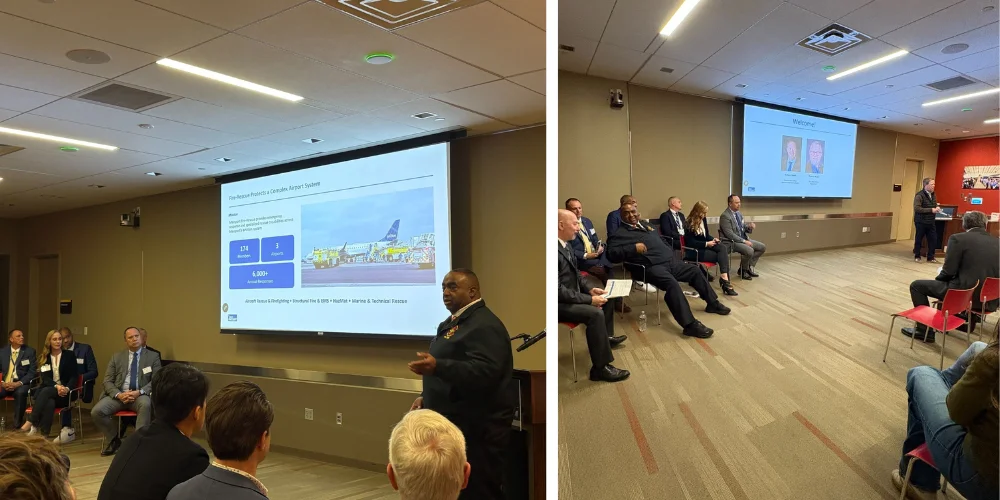
Other needs cut across the airports. Customer Service Deputy Director Mia Healy-Waldron described existing AI wayfinding, digital information and handheld translation tools, alongside exploration of autonomous mobility and crowd monitoring. The ongoing challenge is giving travelers timely, consistent, personal help across a large and changing environment. Fire Chief Joseph DeGrace said Massport Fire-Rescue’s 174 members handle more than 6,000 calls a year across three airports, including maritime, hazardous-materials and technical-rescue incidents. He pointed to tools that could assess hard-to-reach hazardous spaces, improve searches in smoke or underwater, and give incident commanders a clearer live view.
Chief Information Officer Jarett Wright described IT’s move toward closer work with business units on innovation, data and responsible AI. Chief of Security Hank Shaw outlined the need to protect people and critical assets while keeping airport operations moving and maintaining public trust.
Nine startup systems, grouped by airport task
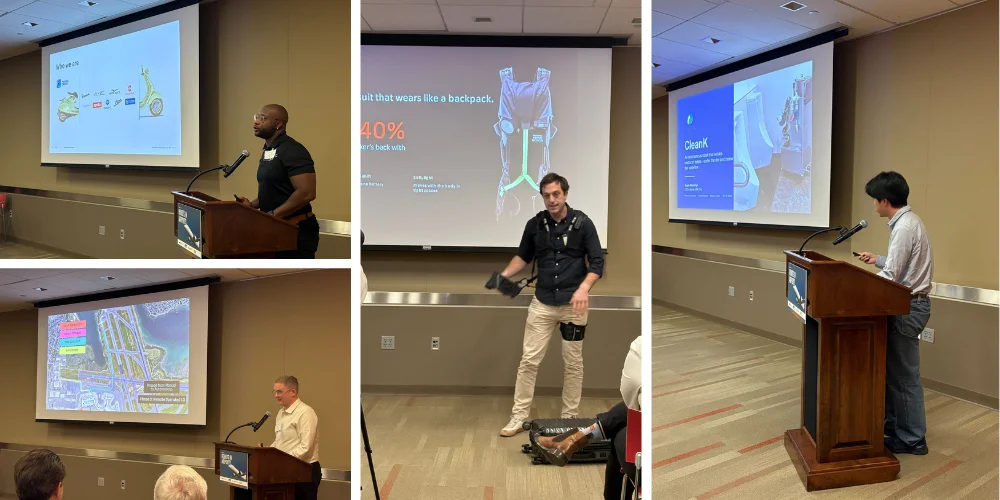
For passenger movement and accessibility, A&K Robotics presented Cruz Mobility Pods, autonomous vehicles intended to let travelers with mobility needs reach their gates independently. The company reported paid pilots with major airport operators, zero safety incidents and high passenger satisfaction. Piaggio Fast Forward showed kilo, a flatbed cart that follows a user, carries up to 300 pounds and requires no mapping or training to begin operation.
Cleaning and waste handling were another focus. CleanK, from inprog USA, demonstrated a robot for scrubbing toilets beneath the rim and below the waterline. The company noted that restrooms account for about 40% of cleaning time while occupying about 5% of floor area. It has piloted the system at Tokyo Innovation Base and is testing at Haneda Airport’s operator test field. rStream uses AI vision to sort waste. At Gillette Stadium during seven matches tied to the FIFA World Cup, the company reported recovering 479,000 recyclables with about 99% sorting accuracy.
Three presentations addressed baggage and ramp work. Verve Motion’s SafeLift is a powered exosuit worn like a backpack; the company says it reduces strain on a baggage handler’s back by up to 40%. In trials with International Airlines Group, 95% of handlers preferred working with it. Airtrek Robotics is automating wingwalking, the manual task of monitoring wingtip clearance during towing and pushback. Its robots have completed more than 70 tows with a fixed-base operator at Oakland County International Airport. Oxcart is developing a high-speed, semi-autonomous electric aircraft tug intended to reduce fuel burn, noise and turnaround time, and is seeking a test at Hanscom.
For airfield inspection, Oreyeon’s Runway Surface Monitoring System mounts on autonomous vehicles to identify foreign object debris and pavement damage. The company reports more than 95% accuracy in day and night operation, with trials at major civil airports in Europe. Snowbotix presented SMUR X1, an electric-hybrid tracked robot with nine interchangeable attachments for tasks including snow removal, mowing, debris sweeping, wildlife deterrence and fence patrol with vegetation clearing. It has logged more than 1,000 uncrewed hours and has been deployed at Gerald R. Ford International and Denver International.
A path from pitch to pilot
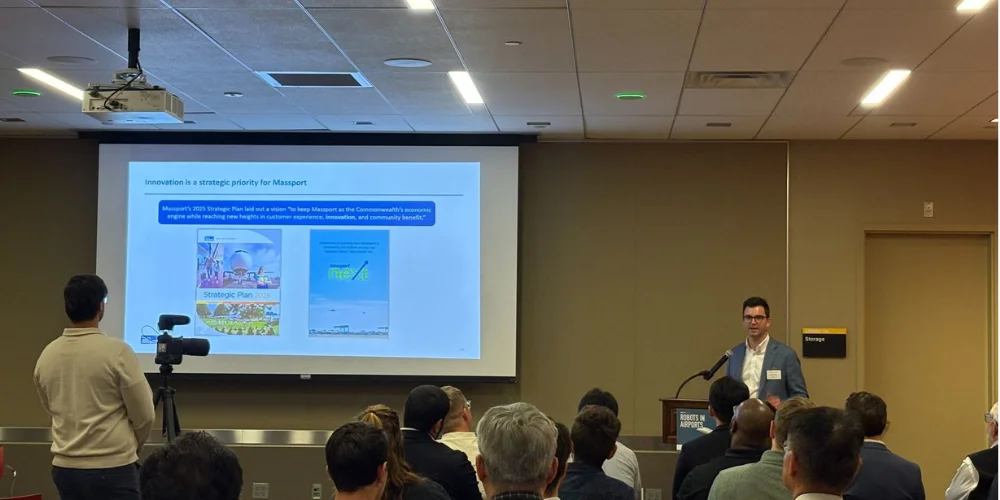
Massport Next, introduced by Assistant Director of Economic Development Conor LeBlanc, is intended to give startups and industry partners an entry point from an initial conversation through a pilot. Innovation is one of the priorities in Massport’s 2025 Strategic Plan, and the program is meant to coordinate work across Massport’s business lines, which include areas such as sustainable aviation fuel and blue technology. The team is seeking ideas through an open Call for Innovation and can be reached at [email protected].
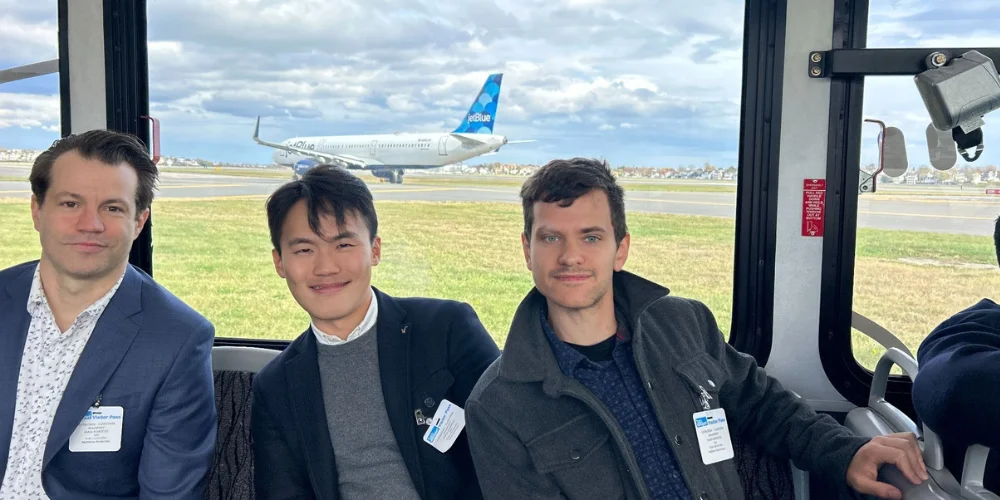
A tour led by Massport Operations gave the startup teams a view of ramp activity and the scale of the airfield that must be inspected and maintained. That context matters: a robot that works in a demonstration still has to fit around aircraft movements, staff workflows and tight operating areas. The event’s next measure will be whether these pitches turn into pilots that address the specific constraints each airport identified.