Wirepas RF Mesh Reaches 700,000 Smart Meters in Himachal Pradesh's Mountain Terrain
- Published
- Author
- IoT.Business.News
- Reads
- 455
Wirepas says its RF mesh now runs inside 7,02,046 smart meters in Himachal Pradesh, where sparse valley coverage and dense hill towns pose opposite problems.
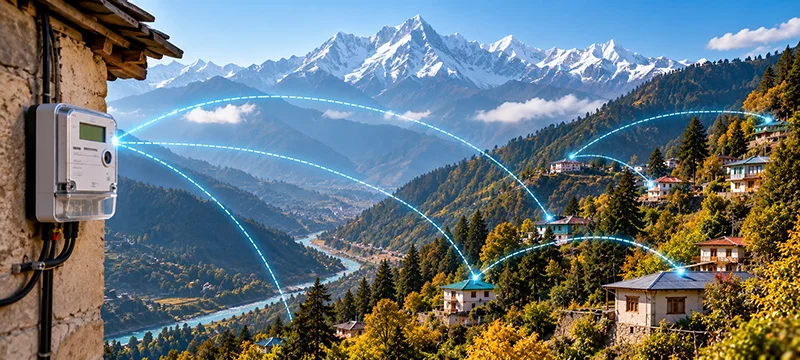
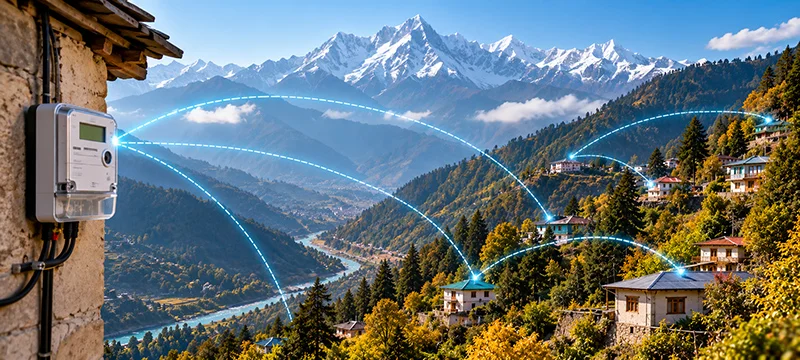
Himachal Pradesh makes a hard test for any metering network. The state sits in the Western Himalayas, where high peaks drop into deep valleys and fast rivers, and villages cling to mountainsides while towns squeeze into whatever flat ground exists. A smart meter here faces two problems that pull in opposite directions. Hill meters sit far apart with little infrastructure between them. Town meters sit close together, often in basements and stairwells where radio signals struggle. Wirepas, the Finnish connectivity company, says its RF mesh now sits inside 7,02,046 smart meters in the state, and that the network is holding its service levels across both settings.
A rapid rollout under a fixed deadline
The numbers behind the deployment show how quickly the installed base is moving. According to the Ministry of Power's data as on 31 December 2025, 28,00,945 consumer smart meters have been sanctioned for Himachal Pradesh under the Revamped Distribution Sector Scheme (RDSS), with 7,02,046 installed. The Ministry's earlier figure for the state, 1,74,360 installed as on 4 March 2025, puts growth at roughly four times in about nine months. The scheme period runs to March 2028, as stated in the Ministry of Power's July 2025 reply, so utilities in the state have a clear window with a large backlog still to install.
That pace changes what a communications layer has to deliver. A network that works for a few thousand pilot meters can hide weak spots. A network that has to absorb hundreds of thousands of meters in a few quarters exposes every coverage gap, every installer shortcut and every site where the radio environment is worse than the survey suggested.
Why terrain, not scale, sets the design brief
In most of India, the metering challenge is volume. In Himachal Pradesh it is geography. Cellular coverage thins out in valleys and behind ridgelines, and dedicated communication infrastructure on steep slopes is slow and costly to build. Urban meters face the opposite issue: many devices in a small area, with building materials and dense structures eating into signal margins.
Wirepas takes a different route from a star topology. In a Wirepas Mesh network, every meter acts as both transmitter and receiver. Meters pass messages to one another, route readings around obstacles or failed nodes, and add coverage as each new meter joins. The architecture has no central hub, so losing one link does not stop data from moving. Wirepas says the deployment needs no dedicated gateways and no SIM cards, which removes both tower construction and recurring connectivity fees from the plan.
The trade-off is worth understanding. Mesh networks depend on density and on nodes being willing to relay traffic, and the energy cost of that relaying falls on the meters themselves. Sparse hill deployments can strain a pure mesh, which is why hybrid designs matter. Here's the thing: the value of mesh grows where density is high, and the question for a sparse valley is whether the nodes can still reach each other. That's where the hybrid option comes in.
Mixing mesh and cellular in one plan
For utilities, the Wirepas Certified connectivity platform supports two meter types: RF-only meters and dual-communication meters that combine mesh with cellular. A single rollout plan can therefore cover dense towns with mesh and remote stretches with cellular-backed connectivity. That approach lets planners settle the communication design before the first meter goes in, rather than discovering gaps in the field. Wirepas states that existing deployments on its platform reach a 99.9 percent service level. That's a vendor figure, and utilities will want to see how it holds up under their own conditions, particularly in the most isolated valleys.
Ashish Sahay, Sales Director and Country Manager, India at Wirepas, framed the deployment in design terms. "Himachal Pradesh is the kind of deployment that tells you quickly whether a technology was designed for India or merely adapted to it," he said. "You have a meter in a village at the top of a valley and another in a crowded stairwell in a hill town, and both need to report on time, every time. Our mesh was built for exactly that range. Extreme terrain, long distances and high densities are not exceptions for us. They are the design brief."
What reliable reading means for distribution utilities
Smart metering sits at the center of the country's push to make distribution utilities financially sustainable. Per the Ministry of Power, national Aggregate Technical and Commercial (AT&C) losses fell from 21.91 percent in FY21 to 15.04 percent in FY25, and the scheme targets a range of 12 to 15 percent. In a mountain state, the operational payoff is concrete. A meter that reports reliably is one that doesn't need a crew to climb to it for a manual read, a bill that doesn't have to be estimated, and a consumption record that can be trusted when disputes arise.
Wirepas says it has worked in India since 2018, with a growing ecosystem of Indian meter manufacturers and AMI solution providers on the Wirepas Certified platform. The platform is built on the open NR+ standard, which the company describes as the world's first non-cellular 5G standard for massive IoT, and it complies with India's IS 15959 DLMS requirements. Wirepas also calls India its largest market worldwide. Himachal Pradesh is one of several states, alongside Assam, Uttar Pradesh and Ladakh, where its networks now run at scale.
Watch the next phase closely. The state's installed base will keep climbing toward its sanctioned total, and the real test will be whether mesh performance in the sparse valleys holds as density changes. If the hybrid model proves its worth in those remote stretches, it could give other mountainous deployments a workable template. Until then, Himachal Pradesh is the proving ground to follow.