LoRaWAN Smart Metering Passes 30 Million Devices as European Utility Demand Grows
- Published
- Author
- IoT.Business.News
- Reads
- 769
More than 30 million meters use LoRaWAN worldwide, while European tender activity and large water deployments point to growing utility adoption.
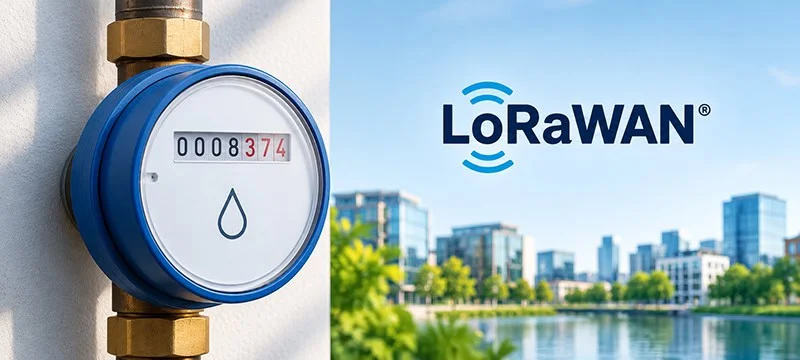
LoRaWAN has moved well beyond small sensor trials in utility metering: more than 30 million meters now use the technology worldwide. That’s more than one fifth of the 150 million LoRaWAN devices connected globally, according to figures the LoRa Alliance presented at Enlit Europe 2026. In Europe, the number of public tenders mentioning LoRaWAN more than quadrupled from 2019 to 2025.
The figures point to two kinds of progress. Procurement activity suggests utilities are considering LoRaWAN for new projects, while deployments reported by network operators and meter suppliers show that the technology is already supporting systems with millions of endpoints. Neither measure alone establishes market share. Together, they show why LoRaWAN has become a serious option for large meter networks.
Water metering drives much of the procurement activity
Kurrant, a strategy and innovation firm that tracks European tenders through its Tender Tracker platform, found that EU-wide tenders referencing LoRaWAN increased approximately 13% in 2025 compared with the previous year. Water metering accounted for around half of these tenders. Building energy metering followed, alongside network infrastructure deployments and street lighting.
France led European procurement activity referencing LoRaWAN, followed by Spain and Germany. A tender mention indicates that a technology is under consideration; it doesn’t establish that a contract was awarded or that a network was built. Even with that limitation, the rise across multiple years suggests LoRaWAN is appearing more often in utility planning beyond experimental deployments.
Water utilities offer a closer look at how that interest is translating into technology choices. Netmore, a LoRaWAN network operator and platform provider, examined publicly announced smart water metering decisions under AMP8. This investment cycle covers water companies in England and Wales from April 2025 to March 2030. In Netmore’s analysis, LoRaWAN featured in 70% of the announced decisions, either as the sole connectivity technology or as the main part of a dual-technology deployment.
That split matters. Utilities don’t always need to select a single communications method for every meter. A dual-technology design can use LoRaWAN as its main layer while assigning another technology to locations or requirements that call for different coverage. Water meters can sit underground or inside buildings, where radio coverage may be harder to achieve. The figures don’t specify how individual utilities are dividing those roles, but they show that mixed architectures are part of the deployment picture.
Existing networks show the scale of deployments
Company-reported deployments provide evidence that LoRaWAN metering has reached operational scale. ZENNER Connect reports 12 million devices connected to its network. Veolia operates more than 4 million active smart meters across France, and Itron has deployed over 3 million LoRaWAN-connected assets, primarily smart water meters.
These counts come from different organizations and describe different network or asset measures, so they shouldn’t be treated as a like-for-like comparison. They do, however, illustrate the scale of infrastructure already in service. A network with millions of endpoints brings operational demands that a limited pilot may not expose: utilities and providers have to manage provisioning, monitor connectivity, maintain devices over time and support equipment from different suppliers.
For engineers choosing a network architecture, radio performance is only one part of that work. The LoRa Alliance identifies firmware updates over the air, relay capabilities and roaming among the features that can matter in deployment. Their value depends on the network design and operating needs; the figures presented don’t quantify performance or establish that every deployment uses them. Still, these capabilities become relevant when planning how a large fleet will be maintained after meters are installed.
Interoperability becomes a lifecycle question
LoRaWAN operates in unlicensed spectrum and is supported by publicly available specifications and a device certification program. Its multi-vendor ecosystem gives utilities the possibility of sourcing compatible equipment from different manufacturers, which can reduce dependence on one supplier. Compatibility and certification don’t remove the need to check that devices, networks and management systems fit a particular deployment, but they provide a basis for building systems across vendors.
The LoRa Alliance counts more than 340 member organizations, including 58 that joined during 2026. Its ecosystem includes over 700 certified devices and nearly 1,000 products listed in the LoRa Alliance Marketplace. Those counts describe the breadth of the ecosystem; they don’t by themselves guarantee that products will interoperate in every system or remain available throughout a meter’s service life.
For meter manufacturers, connectivity providers and system integrators, growth at this scale raises practical expectations. The network must be manageable across a large endpoint fleet, and the equipment and services have to support maintenance over time. For utilities, supplier choice matters most when it works alongside dependable coverage and a workable plan for operating the system over its intended life.
My read is that the most persuasive signal isn’t tender growth on its own. It’s the combination of increased procurement interest with reported networks in the millions, particularly in water metering. The next test is whether operators can keep expanding those systems while maintaining coverage, manageability and interoperability across diverse meter locations and equipment.