Choosing a VLSI Design Partner: Where Engagements Break Down
- Published
- Author
- webmaster
- Reads
- 927
A VLSI partner that looks right on day one can drift off course months later. Here's where resource augmentation, ODC, milestone, turnkey and BOT deals tend to fail.
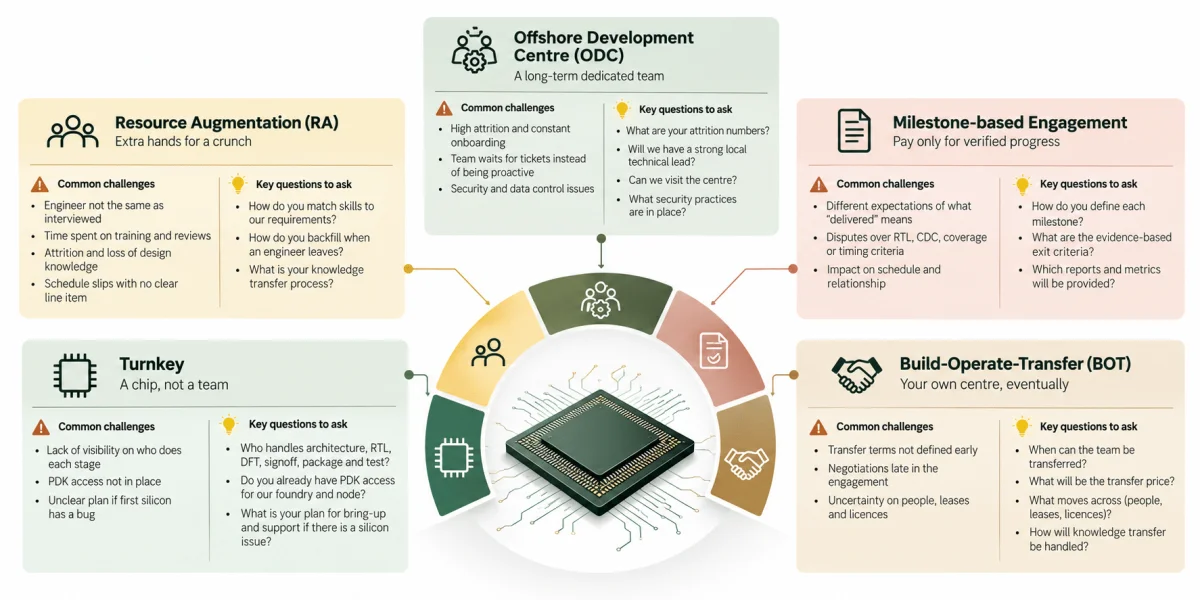
A poor VLSI design partner rarely looks poor at kickoff. The first weeks run smoothly, and the trouble surfaces months later, usually as a schedule slip that nobody can quite trace back to its cause. SignOff Semiconductors, a VLSI services firm, draws on its experience from both sides of the evaluation table, and its view is that the failure mode depends heavily on how the work was engaged. Resource augmentation, offshore centres, milestone contracts, turnkey chips and build-operate-transfer each carry a different kind of risk.
Resource augmentation: capacity that becomes a training load
Resource augmentation looks like the safest option because the customer keeps control and simply adds engineers. That's exactly why its risks are easy to overlook.
The pattern usually begins with a strong interview. The engineer who joins may not be quite the person who was interviewed, or may be capable but unfamiliar with the customer's flow. Senior engineers then spend their afternoons explaining scripts and reviewing basic work. The team may have grown by four on paper, but SignOff describes cases where the existing staff lost a third of their week to supporting the new hires.
The second wave tends to arrive around month four or five. An engineer leaves, often for a better offer, and takes with them everything they learned about the design, because little of it was documented. The replacement needs weeks to become productive, which is the worst possible time for that delay. None of this appears as a line item. It shows up as internal engineering hours and a milestone that moves steadily to the right.
Offshore development centres: when the team never stops being new
An offshore development centre should grow more capable each year as its engineers absorb the customer's designs. With the wrong partner, the curve flattens or reverses.
Year one is usually fine. By year two, the original engineers have started to leave, new people keep arriving, and the team is always partway through onboarding. The design knowledge the customer is paying to build never accumulates. Without a strong local technical lead, the team waits for tickets rather than spotting problems, and managers end up running it remotely across time zones.
Security is the other quiet risk. A centre described as dedicated that turns out to share a network, or that has loose controls over data leaving the environment, can fail a single customer audit. In automotive supply chains, a finding like that can pause the engagement or strain the customer's own relationships with its buyers.
Milestones: agreeing what "delivered" means
Milestone-based terms are fair in principle. The customer pays for delivered work, and the partner is paid as work is delivered. The arrangement only holds up if both sides define "delivered" the same way.
Milestone disputes tend to follow a familiar script. The partner says RTL is complete. The customer opens the code and finds lint warnings, open clock-domain-crossing issues and 70% coverage. Each side is right by its own definition, and the relationship takes damage that didn't need to happen.
SignOff's remedy is a slightly tedious conversation before signing: define every milestone by evidence rather than by a label. "RTL complete" becomes "RTL frozen, lint and CDC clean, 95% functional coverage on the agreed plan." "Timing closed" becomes "zero violations across the agreed corners, reports attached." If the partner doesn't raise this, the customer should.
Turnkey: buying an outcome
Turnkey work is where AI startups, system companies and OEMs often end up. They have a product and a specification, but not a 60-person chip team, and they may not want one.
Turnkey is the deepest level of trust a customer can extend, because they're buying a result rather than hours. Many vendors are strong in some stages and subcontract the rest. That's workable as long as the customer knows exactly who handles each stage. The questions worth asking are direct: who does DFT, who does signoff, who handles packaging and test?
Two more questions matter. First, does the partner already have PDK access for the target foundry and node? Without the NDA in place, nothing else can move. Second, what happens if first silicon has a bug? A partner who has been through bring-up will discuss spare cells, metal-only fixes and a debug plan. That answer reveals more than a tapeout count does.
Build-operate-transfer: planning the handover on day one
In a BOT arrangement, the partner builds and runs a team that will eventually belong to the customer. For a services company, success means handing over what it built, which makes the business model unusual.
The advice SignOff gives every BOT customer is to agree the exit at the start. When can the transfer happen, at what price, and what moves across: people, leases, licences, tools? Raised early, the exit becomes an ordinary planning discussion. Left until year three, it becomes a negotiation, and that rarely serves anyone, least of all the engineers whose jobs are in question.
What to check before signing
"Contributed to" is not "owned." Every services firm presents its track record favourably. "We worked on a 5nm tapeout" could mean closing full-chip timing, or two engineers fixing DRC violations for a month. Both are honest, but they aren't equivalent. Ask what the partner actually owned.
Put a real problem on the table. SignOff says the most useful evaluations it has taken part in weren't presentations. They were working sessions built around one of the customer's actual issues. Two hours of that reveals more about how a team thinks than a month of proposals does, and it tells the vendor whether it's the right fit too.
The cheapest rate is rarely the cheapest chip. One extra iteration, a missed shuttle slot or a respin can erase years of rate-card savings. Compare what the work will cost if things go wrong, not only the hourly figure.
The short version
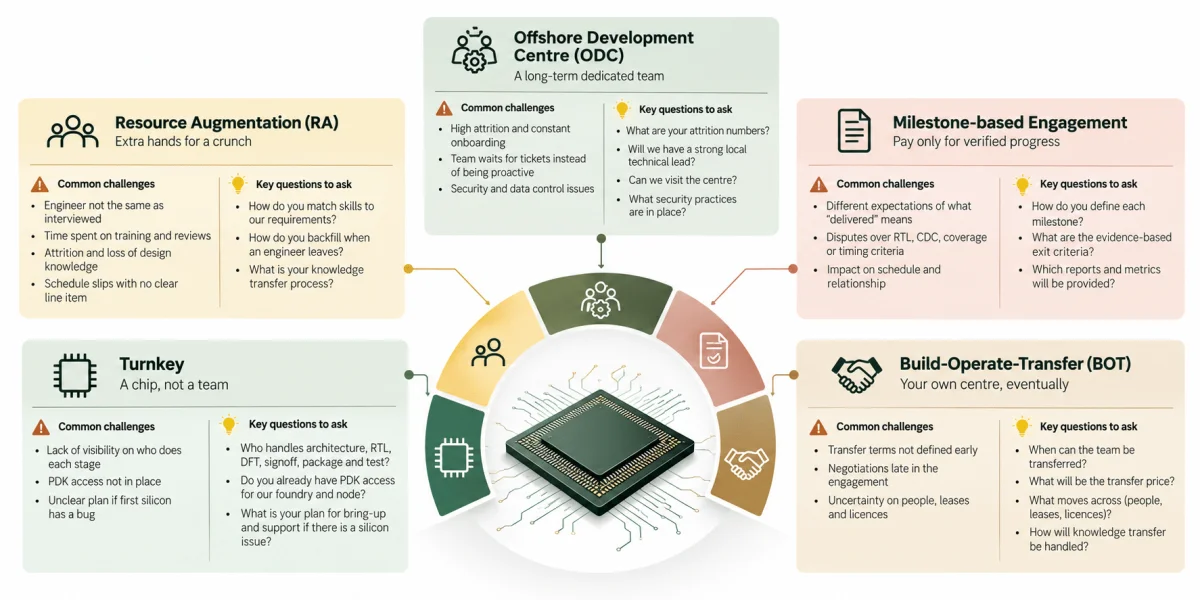
| If you need… | The model | What a good partner should tell you unprompted |
|---|---|---|
| Extra hands for a crunch | Resource augmentation | How they backfill when an engineer leaves |
| A long-term dedicated team | ODC | Attrition figures, and an invitation to see the floor |
| To pay only for verified progress | Milestone-based | Evidence-based exit criteria for every milestone |
| A chip, not a team | Turnkey | Who handles each stage, and the plan if silicon has a bug |
| Your own centre, eventually | BOT | Transfer terms, agreed on day one |
Mixed models often make the most sense. One arrangement SignOff describes keeps RTL in-house, adds external engineers for verification, and hands the backend to a turnkey partner. What matters in any mix is that every party has written down who owns what.
Where SignOff fits
SignOff Semiconductors says it works across these models, including turnkey, ODC, BOT and resource augmentation, often with milestone-based terms. The company reports that its teams have collectively contributed to more than 100 tapeouts, on processes from 180nm to TSMC 2nm. For turnkey programmes, it says it takes a design from architecture or RTL through GDSII and into silicon, coordinating with the foundry, package house and OSAT along the way.
Those figures are the company's own, so treat them as claims to test in the working session rather than as evidence in themselves. The more useful takeaway is the discipline behind them: name the owner of each deliverable, put evidence behind each milestone, and settle the exit before the first engineer starts. Those three steps will expose a poor fit long before the schedule does.