Cyient Semiconductors Pairs Power ICs With Custom ASICs at electronica 2026
- Published
- Author
- Semiconductor For You
- Reads
- 493
Cyient Semiconductors will show Kinetic power and protection ICs, its custom ASIC flow and 800V roadmap work at electronica 2026 in Munich, Hall C6.
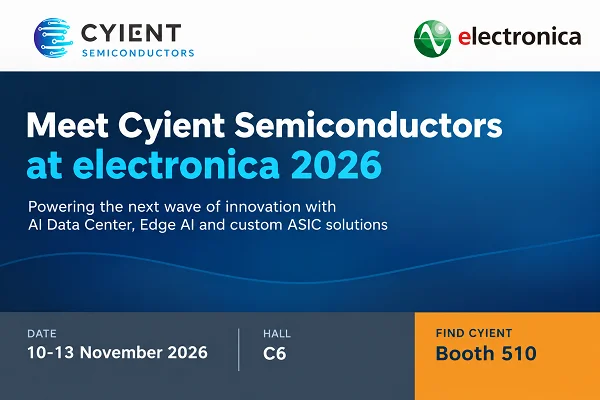
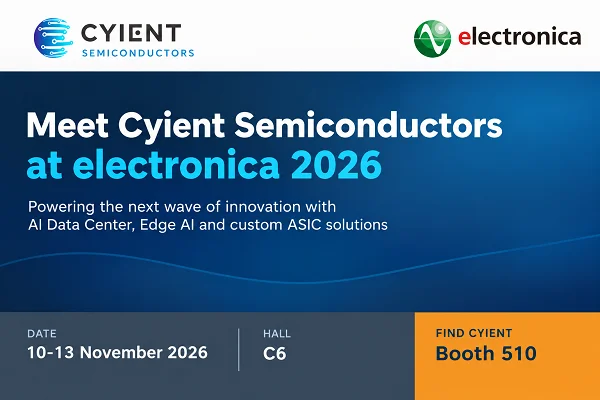
Cyient Semiconductors is bringing a two-track story to electronica 2026: standard power products from its Kinetic Technologies arm, and custom silicon built to a customer's spec. The fabless company will exhibit from 10 to 13 November in Munich, Germany, at Hall C6, Booth 510. What makes the show floor pitch worth a look is the pairing. Off-the-shelf analog and power ICs can carry a design a long way, but a lot of compute, automotive and industrial designs eventually hit a point where a proprietary block is the cleaner answer. Cyient is selling both routes from one company.
Protection and conversion from Kinetic Technologies
Kinetic Technologies, which Cyient describes as its semiconductor products business, is the company's standard-product side. Cyient says the group has shipped more than 3 billion units, offers more than 250 products and holds more than 100 patents. The portfolio covers power management, proprietary IP and high-volume manufacturing and supply-chain capability.
The headline device is the KTS1642Q automotive load switch. Its job is to protect vehicle electronics against reverse-battery, load-dump and other electrical transient conditions. Load-dump is the one that bites most designers: a large voltage spike when a battery disconnects while the alternator is still charging, and a switch that can sit in the path and clamp or cut off the load is a common line of defence. Cyient is positioning the part for automotive designs, and the KTS1642Q is listed among the featured solutions at the show.
On the USB side, Kinetic is showing USB-C protection parts aimed at the move to 48V Extended Power Range. Higher-voltage USB power delivery pushes the protection circuitry to handle more energy per port, and the connector-side fault behaviour gets harder to manage as voltages climb. That's the kind of detail that decides whether a port survives a hot-plug or a miswired cable.
For conversion, Kinetic's fast-transient buck regulators target edge AI platforms and advanced SoCs. The design problem here is load steps. An accelerator that jumps from idle to full draw in a few microseconds can pull the rail well outside its window unless the regulator's loop responds quickly. Cyient describes these parts as responding rapidly to changing loads, which is the right thing to emphasise. The practical questions for a designer are how much output capacitance the regulator needs to hold its transient spec, and how the board layout affects the result. Those answers come from the datasheet and bench measurements, not the booth headline.
Custom ASICs from architecture to production silicon
On the custom side, Cyient sells turnkey ASIC development that combines high-precision analog and mixed-signal circuitry, RF, IoT connectivity, embedded power and digital processing. The company says the work covers architecture, design, prototyping, qualification, manufacturing coordination and continued silicon supply.
That last item matters more than it sounds. Many custom chip projects stall between tape-out and volume production, when the customer discovers that qualification and supply continuity are harder than the design itself. A vendor that takes responsibility for the whole chain, from architecture through to ongoing supply, changes the risk profile of a project, especially for products with long field lives. Cyient lists medical, industrial, communications, data center and automotive markets among its target applications.
The 800V roadmap is still in development
The most forward-looking item is Cyient's 800V high-voltage power work for AI data centers, industrial and factory automation, and e-mobility. The company says these technologies remain under development as part of its next-generation roadmap, so nothing in the release should be read as a shipping part.
Still, the reasoning behind it is easy to follow. Rack power densities in AI data centers keep rising, and moving distribution to higher bus voltages cuts current for a given power level, which lowers conductor losses and copper cost. Here's the thing, though: higher voltage tightens the design problem everywhere else. Creepage and clearance distances grow, insulation and isolation need more attention, and switching devices and gate drivers have to tolerate larger transients. Teams in this position typically find that the magnetics, layout and test procedures change as much as the power stage itself. Cyient's release doesn't give device types, switching topologies or ratings for the 800V work, so the detail that matters will have to come from later disclosures.
What the CEO is pointing to
Suman Narayan, CEO of Cyient Semiconductors, framed the company's strategy this way: "We are building a global semiconductor product company by combining differentiated power IP with turnkey custom silicon." He tied that to scale, saying Kinetic Technologies is already shipping approximately 250 million units annually, supported by a global manufacturing, packaging, test and supply-chain network. He added that the combination of that execution scale, the custom ASIC capability and the power management roadmap lets the company support customers from innovation through reliable production supply.
Read against the numbers Cyient gives elsewhere, the cumulative shipment figure of more than 3 billion units and the annual run rate of about 250 million are consistent with a mature, high-volume product line. The claim that matters for engineers is narrower: the company wants to be seen as a supplier that can move a design from a standard IC into a custom die without changing vendors.
Where to see it
Cyient Semiconductors and Kinetic Technologies will be at electronica 2026 in Munich from 10 to 13 November, Hall C6, Booth 510. Cyient says teams can arrange a meeting through its electronica 2026 contact page. If you're evaluating a 48V USB-C design, an automotive port that needs transient protection, or an edge AI board with a fast-moving load, the booth is a reasonable place to ask for the datasheet, the application notes and the supply plan in the same conversation. The 800V work is the one to track over the coming year, because the details on devices, ratings and sampling will show whether it reaches designers on the timeline the roadmap implies.